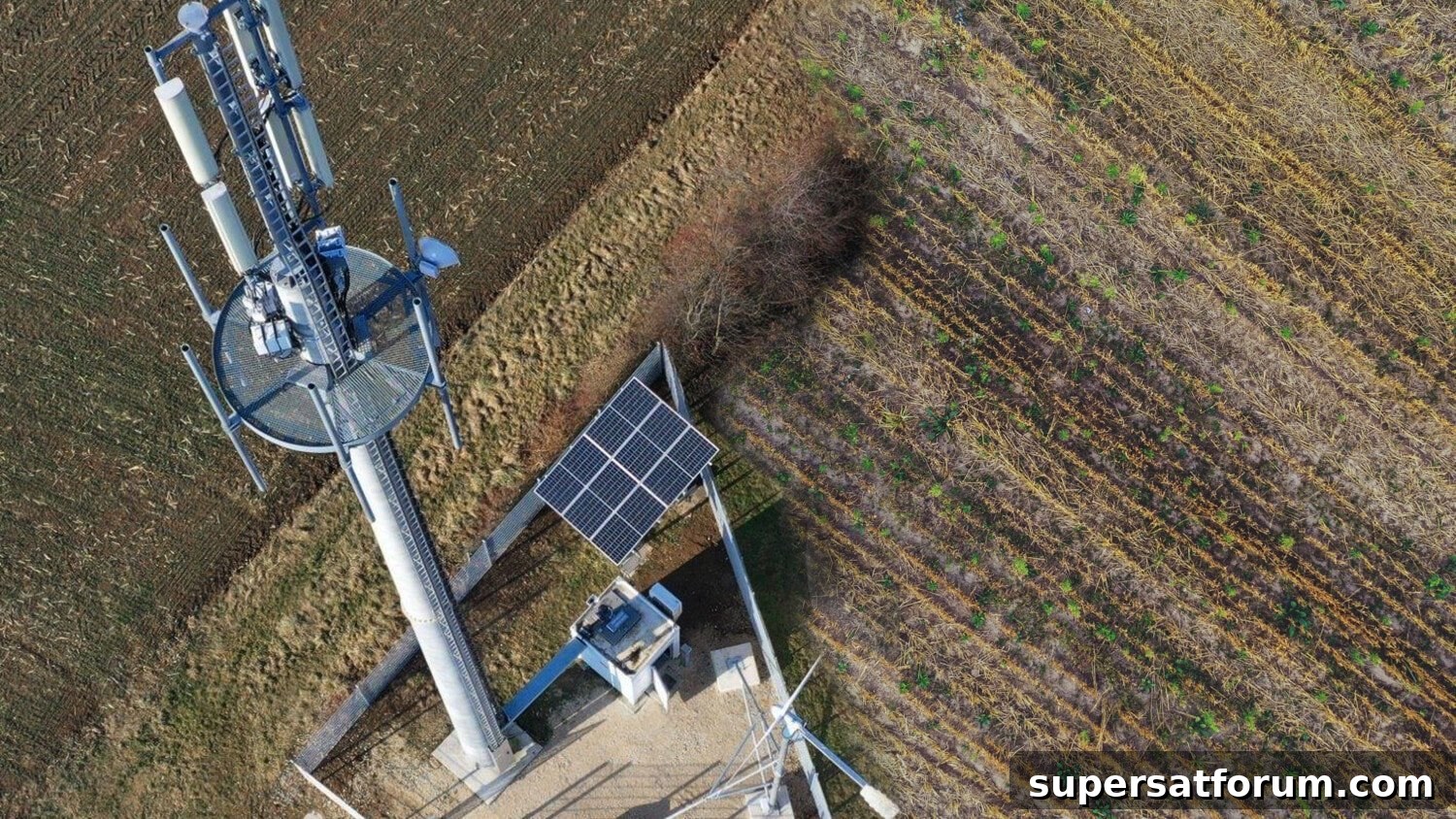
Ericsson has joined forces with Deutsche Telekom (DT) to accelerate the use of renewable energy for powering 5G radio sites.
Transitioning to renewable energy for telecom infrastructure is increasingly urgent. Beyond cutting greenhouse gas emissions, renewables reduce dependence on fossil fuels sourced from regions where revenues may fund conflict or other harmful activities.
Heather Johnson, Vice President for Sustainability and Corporate Responsibility at Ericsson, said:
“At Ericsson, we are committed to working with our customers to support them in cutting their carbon emissions.
This partnership is a great example of how we’re achieving this through our best-in-class energy-efficient equipment, which can be operated entirely with renewable energy.”
Together, Ericsson and Deutsche Telekom converted an operational 5G site in the Bavarian municipality of Dittenheim to run primarily on renewable energy.
The site had been partly powered by solar panels since it opened more than a year ago. The installation includes around 12 m² of solar modules and has been supplemented with a small wind turbine capable of producing up to five kilowatts of additional power. With both solar and wind inputs, the site can draw renewable energy under a variety of weather conditions.
An Ericsson-designed energy management solution controls and balances supply and demand to maximize the contribution from solar and wind. The system is engineered so the site can, in theory, operate independently of its connection to the electrical grid when renewable generation and stored energy are sufficient.
Leif Heitzer, Senior Vice President of Technology Guidance and Economics at Deutsche Telekom, commented:
“Ensuring an integrated management of clean, efficient, and reliable power sources and usage is key for sustainable mobile site operations.
Together with innovative partners, we explore in trials how we can apply intelligent solutions and capabilities to optimise energy consumption and control at mobile sites.”
The companies report that on windy days the site produced more renewable energy than it consumed. A diesel generator remains available as an emergency backup, while additional low-emission backup options such as fuel cells are planned for near-term integration.
This pilot demonstrates several practical benefits for mobile-network operators: lower operating emissions, reduced reliance on grid-supplied fossil electricity, and improved resilience in remote or grid-constrained locations. Intelligent energy management also allows networks to match power use to renewable availability, further reducing fuel consumption and operational costs over time.
As mobile networks expand and energy demand from 5G increases, scalable renewable solutions and smarter site control systems will be essential. Trials like the Dittenheim site provide real-world insights into how solar, wind, storage and intelligent control can combine to keep sites online with minimal carbon footprint.
Both Ericsson and Deutsche Telekom emphasize that broader deployment will require continued investment in site-level hardware, energy storage, and hybrid backup technologies, along with software to coordinate these elements efficiently. Policymakers and industry stakeholders also play a role by supporting grid modernization and incentives for clean-energy adoption.
The Dittenheim project serves as a concrete example of how telecommunications companies can reduce emissions and increase energy independence by pairing energy-efficient radio equipment with renewable generation and smart control systems.
(Image Credit: Ericsson)