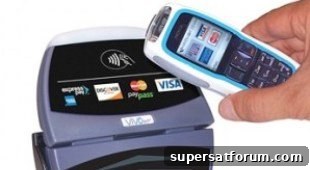
A Juniper Research report predicts the mobile payments and NFC market will grow dramatically, reaching more than $180 billion within five years — roughly seven times this year’s level.
Western Europe is expected to account for just over a third of that total (35%), with North America contributing about 30% and the Far East including China making up roughly 26%.
To put that growth into perspective, Juniper forecasts that by 2017 one in four people in Western Europe and the United States will be using NFC for payments.
“This is a critical time for the NFC retail payments market,” said report co‑author Dr. Windsor Holden. He added that although progress is significant, the market’s full potential depends on equal commitment from all ecosystem players and the continued involvement of mobile wallet consortia.
Barcodes on steroids or the new Betamax?
Earlier this month, news of Deutsche Telekom’s reported talks with Google about a payments app prompted commentary that NFC could be “a game‑changer” in the mobile payments space. Google Wallet is already NFC‑enabled, and the technology’s momentum is hard to ignore.
Juniper’s report emphasizes that enthusiasm for NFC payments is rising. One vendor quoted in the report described NFC as “barcodes on steroids,” highlighting the perception that NFC can dramatically speed and simplify transactions.
Despite the optimism, the report also flagged challenges. Many merchants remain unconvinced that NFC offers clear advantages over established payment systems — particularly in markets where Chip & PIN has been recently adopted — and are reluctant to invest in a technology that is still maturing.
It’s important to recognize that NFC’s potential extends beyond payments. For example, reports suggest Nintendo plans to include an NFC chip in the Wii U console, demonstrating how the technology can be used for gaming, access control, loyalty and other proximity interactions.
Juniper also noted that adding an “NFC dimension” brings complexity that can detract from NFC’s naturally elegant interactions. That complexity can stem from several sources: vendor and mobile wallet readiness, consumer familiarity and comfort, merchant integration, and support and customer care processes.
NFC is not the only route to mobile transactions. Competitors like PayPal are developing alternative models such as PayPal Wallet that do not rely on NFC. Some market analysts have argued that NFC will not suffer the fate of technologies like Betamax because it offers a clear differentiator.
Yankee Group analysts, for example, argued that NFC’s tap‑and‑go model delivers a compelling user experience. Nick Holland, a senior analyst, said the simplicity of tapping a device to pay versus launching an app, scanning a code or entering a PIN makes NFC elegant, universal and more enjoyable for consumers.
PayPal’s non‑NFC approach typically requires upgrades or changes on the retailer side, though the company has explored ways to enable similarly seamless interactions, including concepts that mimic tap‑and‑go behavior without NFC hardware.
The debate ultimately centers on priorities for payment systems: is simplicity of use enough to make NFC the default method, or will other factors — cost, merchant readiness, security, standards and ecosystem cooperation — determine the winner? NFC’s promise of an intuitive, fast payment experience positions it strongly, but adoption will depend on coordinated efforts among device makers, payment networks, merchants and wallet providers.
As the market evolves, stakeholders must address the technical, commercial and customer‑facing challenges to realize NFC’s benefits. If mobile wallet initiatives stay coordinated and investment follows, NFC could become a mainstream payment option across multiple regions and use cases. If fragmentation and uncertainty persist, alternative models may continue to compete for prominence.
Either way, the coming years look set to be decisive: NFC’s convenience and potential for broad use cases give it a strong case for growth, but widespread adoption hinges on tangible improvements in merchant support, consumer confidence and ecosystem alignment.