Amazon has revealed the first customer terminals for Project Kuiper as it prepares to compete with SpaceX’s Starlink.
Project Kuiper is Amazon’s initiative to deploy a constellation of 3,236 low Earth orbit satellites to deliver high-speed internet to locations around the globe.
“Our goal with Project Kuiper is not just to connect unserved and underserved communities, but also to delight them with the quality, reliability, and value of their service,” said Rajeev Badyal, Amazon’s vice president of technology for Project Kuiper.
Amazon plans to begin launching Kuiper satellites in 2024. Two prototype satellites are scheduled to deploy after riding aboard United Launch Alliance’s Vulcan Centaur rocket in May.
Over the next five years, the company intends to launch roughly 1,500 additional Kuiper satellites as it builds toward full constellation deployment.
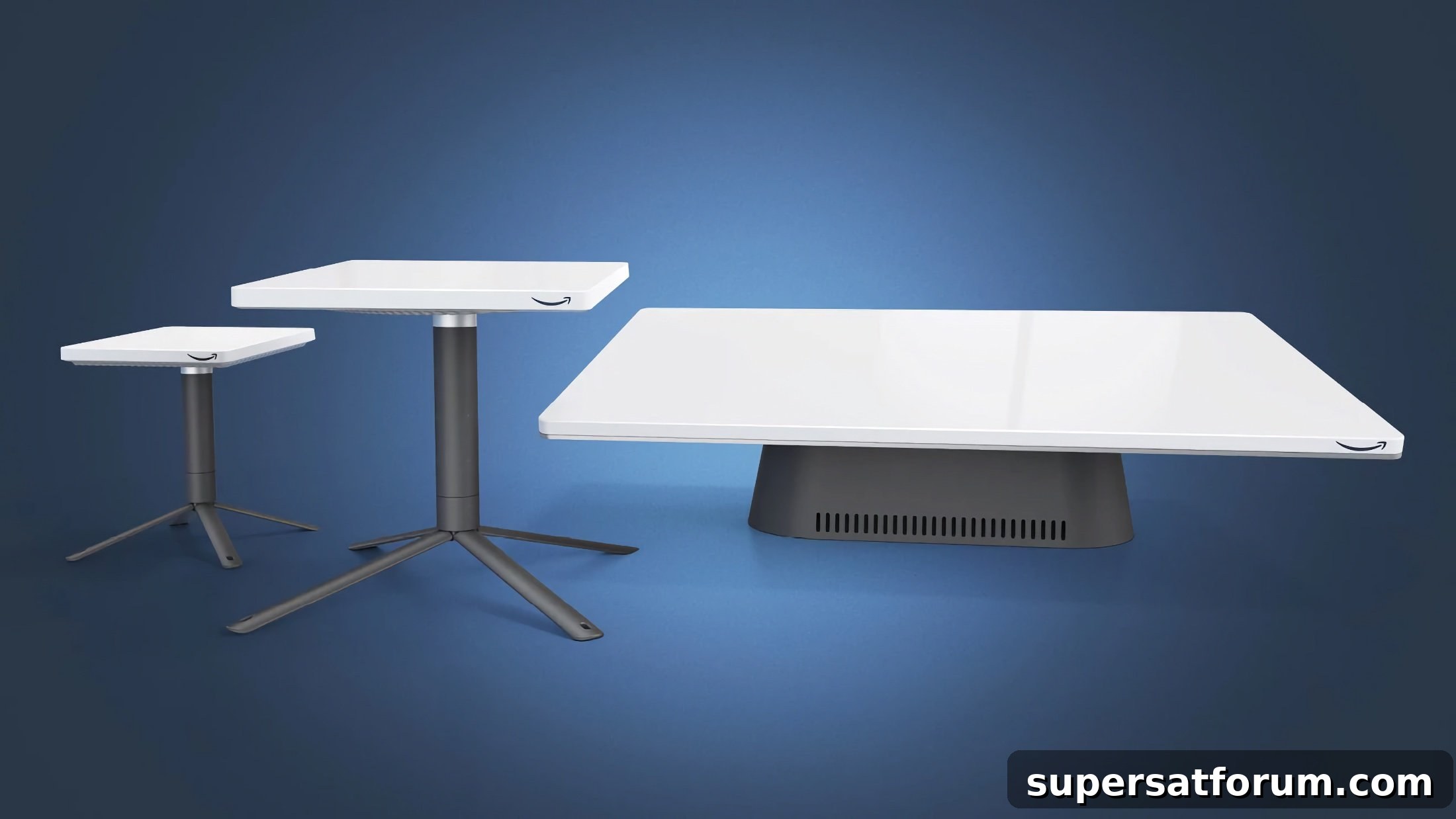
Ahead of those launches, Amazon has shown the first-generation terminals customers will use to access the network.
The largest terminal measures approximately 19 by 30 inches—roughly the size of a small patio table. Designed for government and telecommunications providers, this model is engineered to deliver speeds up to 1 Gbps.
The consumer-focused terminal is much smaller, about 11 inches square, and Amazon says it will support speeds up to 400 Mbps.
Amazon developed its own baseband chip for the terminals, codenamed Prometheus. According to the company, the chip offers processing comparable to a modern 5G smartphone modem, the traffic-handling capacity of a cellular base station, and the point-to-point performance of a microwave backhaul antenna.
A primary design objective was cost efficiency. Amazon says its Kuiper terminals cost under $400 to manufacture.
By comparison, Starlink terminals have reportedly cost around $1,500 each to produce in recent years, down from roughly $3,000 initially. SpaceX has sold consumer terminals for $599, locally subsidizing hardware costs and recovering investment through monthly service fees that can start near $100 per month.
Amazon has not yet announced final pricing for Kuiper terminals or subscription plans, but the lower manufacturing cost gives the company considerable flexibility in pricing and deployment strategies.
“From day one, every technology and business decision we’ve made has centred on what will deliver the best experience for different customers around the world, and our range of customer terminals reflects those choices,” Badyal added.
While Amazon’s hardware shows promise, the company still faces the challenge of catching up to more mature competitors. Starlink already operates over 3,000 satellites out of a planned fleet of nearly 12,000 and has seen extensive operational use in demanding environments.
(Imagery Credit: Amazon)
Looking to revamp your digital transformation strategy? Learn more about Digital Transformation Week taking place in Amsterdam, California, and London. The event is co-located with the IoT Tech Expo.
Explore other upcoming enterprise technology events and webinars powered by TechForge.