
In its latest analysis of UK mobile network experience, Opensignal confirms EE as the market leader, winning 10 of 14 awards in its report based on data collected from June to August 2024. The findings highlight a competitive market, with EE leading across multiple user-experience categories while rivals make targeted gains.
Notably, EE earned the ‘Reliability Experience’ award for the first time, scoring 881 on a 1,000-point scale and narrowly edging out Vodafone’s 874. This reflects consistent performance and dependability for EE customers across the measured period.
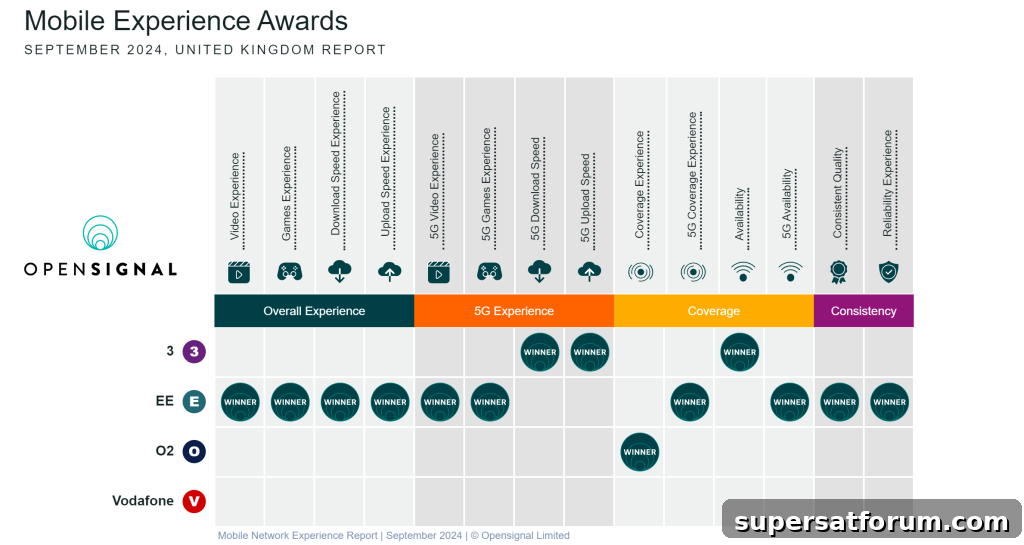
Coverage remains a contested area. O2 topped the ‘Coverage Experience’ metric with an 8.9 score out of 10, slightly ahead of EE’s 8.6. That measure evaluates how well networks provide service across 2G, 3G, 4G, and 5G in places where people live, work, and travel, making it a key indicator of everyday reach.
EE also dominated media-centric categories. The operator regained leadership in both ‘Video Experience’ and ‘Games Experience’—including their 5G-specific awards—after previously sharing the video accolade with Vodafone. These wins indicate superior streaming smoothness and gaming responsiveness for EE users.
On 5G performance, EE continues to stand out. It took home both the 5G Availability and 5G Coverage Experience awards, suggesting EE customers can access 5G more frequently and in a wider range of locations than customers on other UK networks.
However, Three made meaningful progress on 5G speed. Opensignal’s data shows Three users experience the fastest download and upload speeds when connected to 5G, underscoring important improvements in its network performance even if it does not lead across all categories.
The UK mobile market has undergone significant change in recent years. EE and Vodafone have launched commercial 5G standalone (SA) services—EE covering 15 major cities—and both operators completed their 3G network shutdowns in February 2024 to free up spectrum and improve modern smartphone performance.
Since Virgin Media’s acquisition of O2 in 2021, the combined firm has offered integrated “supercharged” bundles of mobile, TV, and broadband that directly challenge EE’s offerings. In March, Virgin Media O2 trialled new methods to boost mobile coverage by leveraging Virgin Media’s fixed network and deploying smart poles, indicating a continued focus on converged infrastructure.
Industry consolidation is another major theme. A proposed merger between Vodafone and Three has attracted regulatory scrutiny, with both companies arguing a combined operation is needed to better compete with EE and Virgin Media O2. The Competition and Markets Authority (CMA) is expected to complete its review of the deal’s potential impact by December 2024.
Opensignal’s report suggests that a successful Vodafone–Three merger could create a stronger rival to O2 in Coverage Experience, reshaping competitive dynamics depending on regulatory outcomes.
As the UK market evolves—driven by 5G rollout, network modernization, and possible consolidation—competition to provide the best overall customer experience remains intense. EE currently leads in many categories, but continued investments by rivals and structural changes in the industry mean the ranking of operators could shift over the coming years.
(Image Credit: EE)
See also: IMT‑2030 Vision: Industry experts outline the path to 6G

Unified Communications is a two-day event held in California, London, and Amsterdam that explores the future of workplace collaboration in an increasingly digital world. The event is co-located with conferences focused on digital transformation, IoT, edge computing, intelligent automation, AI & big data, and cybersecurity & cloud technologies.
Discover other upcoming enterprise technology events and webinars powered by TechForge.