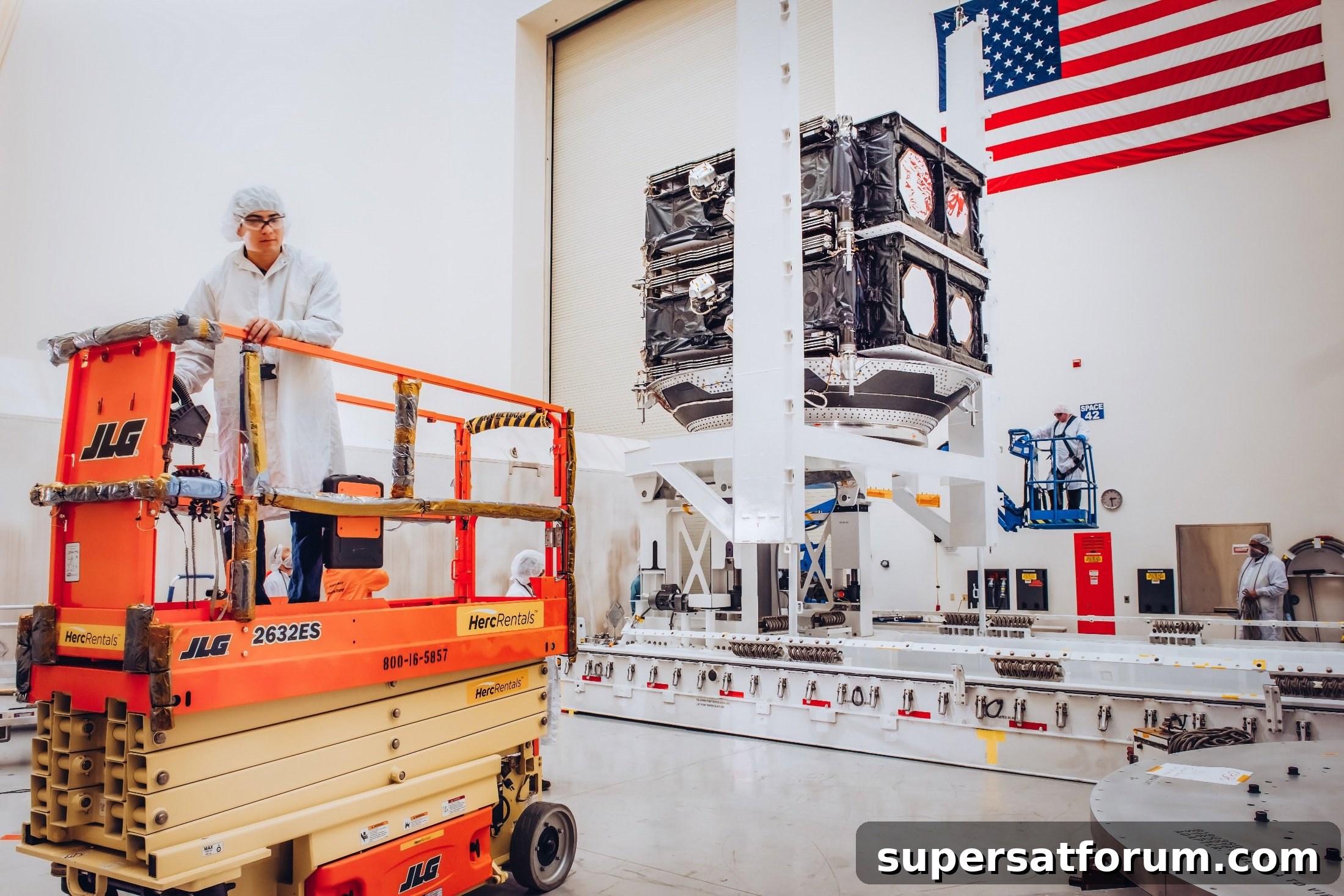
Boeing took a pointed swipe at Starlink while announcing the delivery of the first two O3b mPOWER satellites to Luxembourg-based telecom operator SES.
“SES’s O3b mPOWER system is a true gamechanger and will transform the way people think about connectivity,” said Ruy Pinto, CTO at SES.
“Delivering performance above all, O3b mPOWER will provide connectivity services to government organisations and enterprises in the most remote regions. In times of natural disasters, when terrestrial networks are disrupted, O3b mPOWER’s low-latency capabilities can quickly restore critical communications.”
Each O3b mPOWER satellite carries more than 5,000 steerable beams capable of allocating power dynamically to where it is needed. Boeing says this design gives its satellites an advantage over competitors.
“Rather than relying on fewer, larger fixed beams or a proliferated Low Earth Orbit (LEO) constellation covering vast regions—approaches that can struggle to meet high-density demand—the software-driven O3b mPOWER system uses shapeable beams that can be repositioned using real-time data from SES customers’ terminals, delivering a superior end-user experience,” Boeing said in a press release.
Boeing’s statement appears aimed at Starlink. Unlike Starlink, which relies on thousands of LEO satellites and has rapidly expanded its constellation—raising concerns among astronomers—Boeing’s system takes a different approach. Amazon’s upcoming Project Kuiper will add further LEO capacity in the years ahead, increasing the number of objects operating at lower altitudes.
Boeing’s O3b mPOWER satellites operate in Medium Earth Orbit (MEO), roughly 5,000 miles (8,000 km) above Earth.
MEO aims to balance the wide coverage of geostationary satellites with the low-latency performance and higher speeds associated with LEO systems.
Those higher MEO altitudes expose satellites to increased radiation. To address this, Boeing subsidiary Spectrolab custom-designed solar arrays and other radiation-hardened components for the O3b mPOWER satellites.
Boeing is contracted to deliver 11 O3b mPOWER satellites to SES.
“SES approached us with a vision to create global equity by providing high-speed connectivity where it wasn’t economically or physically feasible to build fiber infrastructure,” said Jim Chilton, Senior Vice President of Space and Launch at Boeing Defense, Space & Security.
“We partnered to build what is effectively a supercomputer constellation in space to achieve that goal, and we look forward to seeing how SES leverages the 702X platform as its first operator.”
(Image Credit: © Boeing)
Related: Starlink terminals now cost double in Ukraine
Looking to revamp your digital transformation strategy? Learn more about Digital Transformation Week, held in Amsterdam, California, and London. The event is co-located with the IoT Tech Expo.
Discover other upcoming enterprise technology events and webinars powered by TechForge.