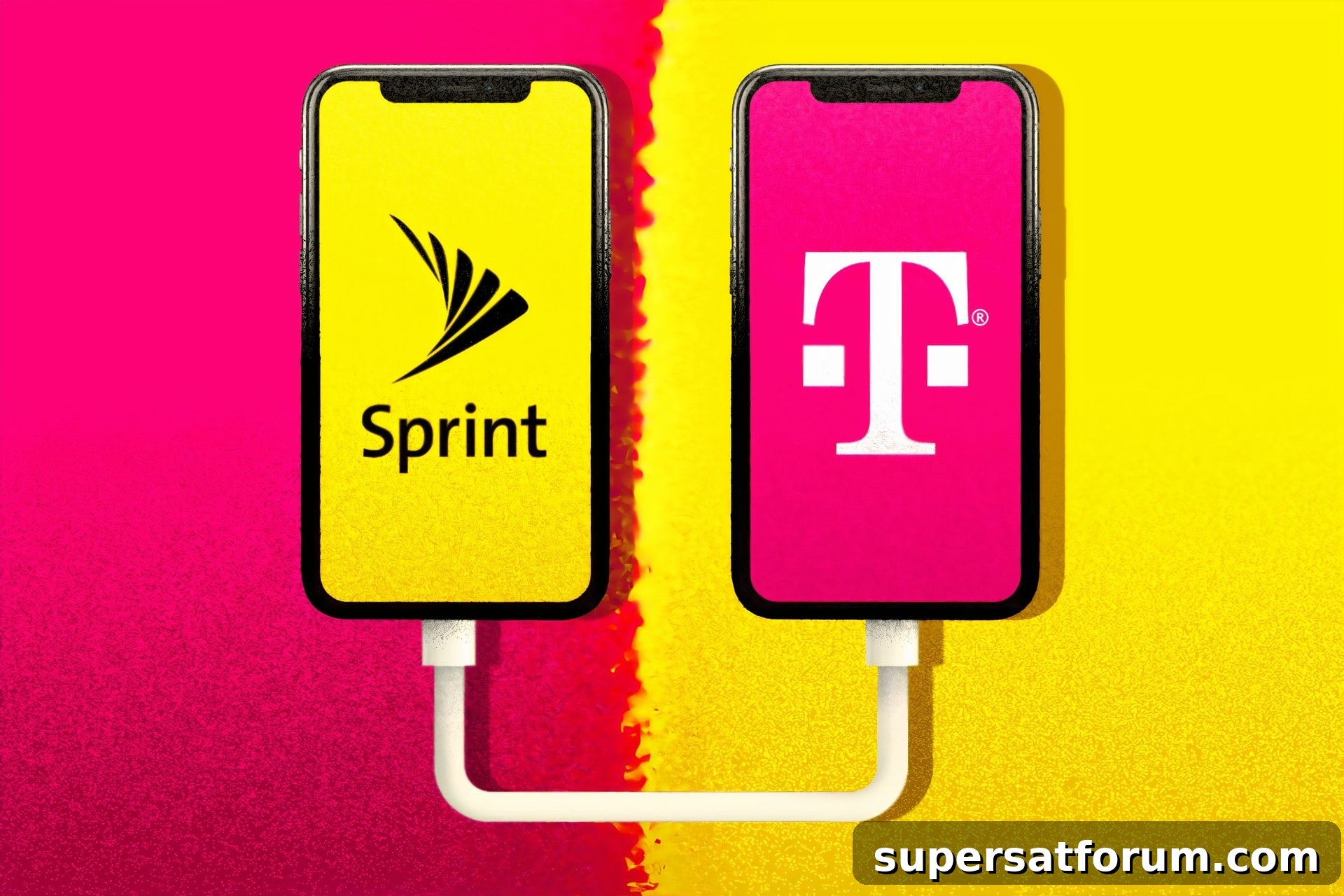
T-Mobile has begun decommissioning Sprint’s legacy 5G network following the companies’ merger, which officially closed on April 1. The carrier is taking Sprint’s 2.5GHz mid-band 5G offline as part of a planned process to re-deploy that spectrum across T-Mobile’s network.
Most former Sprint customers will no longer be able to access 5G with their existing devices; Samsung Galaxy S20 models are an exception and will continue to work. To help affected subscribers transition, T-Mobile is offering credits to lease compatible 5G devices.
T-Mobile has already activated its newly integrated 2.5GHz spectrum in New York, marking the first market where the operator offers low-, mid-, and millimeter-wave 5G together. The carrier’s 2.5GHz service is also live in parts of Chicago, Houston, Los Angeles, New York and Philadelphia as T‑Mobile integrates Sprint assets into its nationwide footprint.
According to data from Opensignal, customers on T‑Mobile’s mid-band 5G are seeing average download speeds around 330 Mbps. The mobile analytics firm ranks T‑Mobile highest for 5G availability, reporting that T‑Mobile customers receive a 5G signal roughly twice as often as AT&T customers and far more frequently than Verizon users.
“Building the fastest 5G network is easy if you only cover less than 50 square miles. Opensignal’s report shows that only T‑Mobile is doing the hard work to deliver BOTH 5G coverage and speed. And we’re just getting started,” said Neville Ray, President of Technology at T‑Mobile.
Ray added that with Sprint’s spectrum and infrastructure now part of T‑Mobile, the Un‑carrier’s 5G footprint is becoming “bigger, better and faster every day,” as the company pushes toward its goal of building a nationwide 5G network.
Regulatory approval for the merger was finalized on April 1 after discussions and negotiations that began in 2013. As part of the approvals, T‑Mobile agreed to several conditions intended to preserve competition and consumer choice. Those measures included selling Sprint’s prepaid businesses—Boost Mobile and Virgin Mobile—and divesting Sprint’s 800 MHz spectrum holdings to Dish Network for $1.4 billion. Those transactions were completed as required.
Last month, T‑Mobile petitioned the California Public Utilities Commission (CPUC) to relax some post‑merger conditions it originally agreed to. The requests sought relief from commitments tied to job creation during the COVID‑19 pandemic, specific average 5G coverage and speed targets, and the requirement for a third independent network test, which the carrier characterized as burdensome.
(Photo by Morning Brew on Unsplash)
Interested in industry events and expert discussions on topics like this? Consider attending co‑located industry expos such as 5G Expo, IoT Tech Expo, Blockchain Expo, AI & Big Data Expo, and Cyber Security & Cloud Expo, which run events in locations including Silicon Valley, London and Amsterdam.