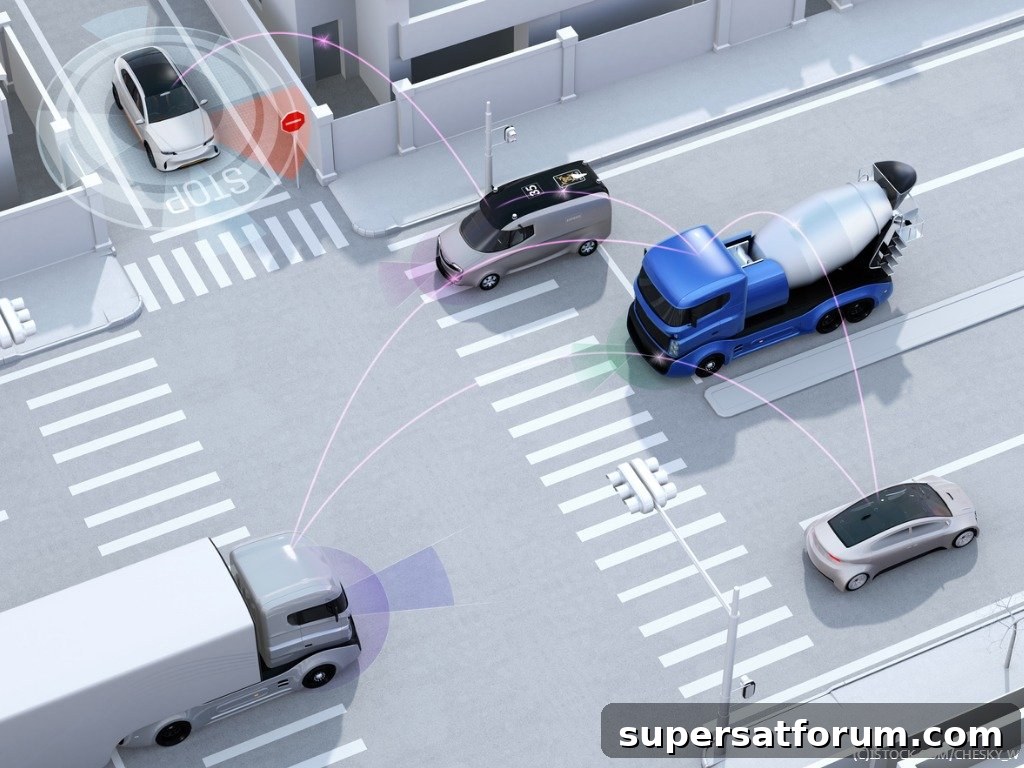
Communications service providers (CSPs) must act now, Gartner warns, as the rise of 5G opens growing opportunities in autonomous vehicle connectivity.
Gartner says CSPs can secure future market opportunities with autonomous vehicle manufacturers by offering services in areas such as driver safety, data processing and vehicle data management.
The volume of data involved will be enormous. By 2025, autonomous vehicles are expected to upload more than 1 terabyte of vehicle and sensor data to the cloud per month, compared with around 30 GB today. To make that transfer seamless and reliable, CSPs should ensure 5G becomes a core design requirement for next-generation vehicles.
Although Gartner expects only limited direct benefits from 5G within the next five years, it stresses that CSPs need to prepare immediately. “By design, AVs cannot rely on mobile networks such as 5G for core functionality, but most utilise multiple technologies to meet performance and safety design objectives,” said Jonathan Davenport, senior research analyst at Gartner. “Nevertheless, 5G networks will play a crucial role in handling the massive amounts of data generated by AVs and their users for all kinds of purposes, including safety, connectivity and entertainment.”
From a safety perspective—particularly in light of high-profile incidents involving self-driving cars—Gartner highlights remote piloting as a plausible mitigation approach. Reliable, low-latency 5G connectivity would be essential for remote pilots to intervene effectively when needed.
“Autonomous vehicles periodically encounter conditions they cannot immediately navigate, creating the need for a vehicle‑to‑human handover,” Davenport explained. “This handover deactivates autonomous mode and transfers control to a human driver, but such a transfer is not always possible. Human pilots can receive a planned remote handover or assist in recovering an AV that has become stuck.”
Widespread full autonomy remains unlikely in the near term. Industry leaders have repeatedly suggested that mainstream adoption of fully self-driving cars could take a decade or more. In the meantime, a major challenge for the industry will be delivering end-to-end data connectivity and compatibility to original equipment manufacturers (OEMs).
“CSPs have to build support for their 5G technologies and establish them as the de facto communication standard,” Davenport added. “This is best achieved by participating in standards committees and collaborating with local governments to enable advanced use cases, such as metropolitan traffic management.”
Interested in hearing industry leaders discuss topics like this and sharing IoT use cases? Events such as industry expos and conferences feature tracks on smart cities and connected transportation, bringing together CSPs, OEMs, policymakers and technology providers to explore real-world deployments, regulatory challenges and technical standards.
Conference programs commonly include sessions dedicated to smart energy and city infrastructure, as well as connected transportation, enabling attendees to learn how 5G, edge computing and data platforms can support safer, more efficient autonomous mobility systems.