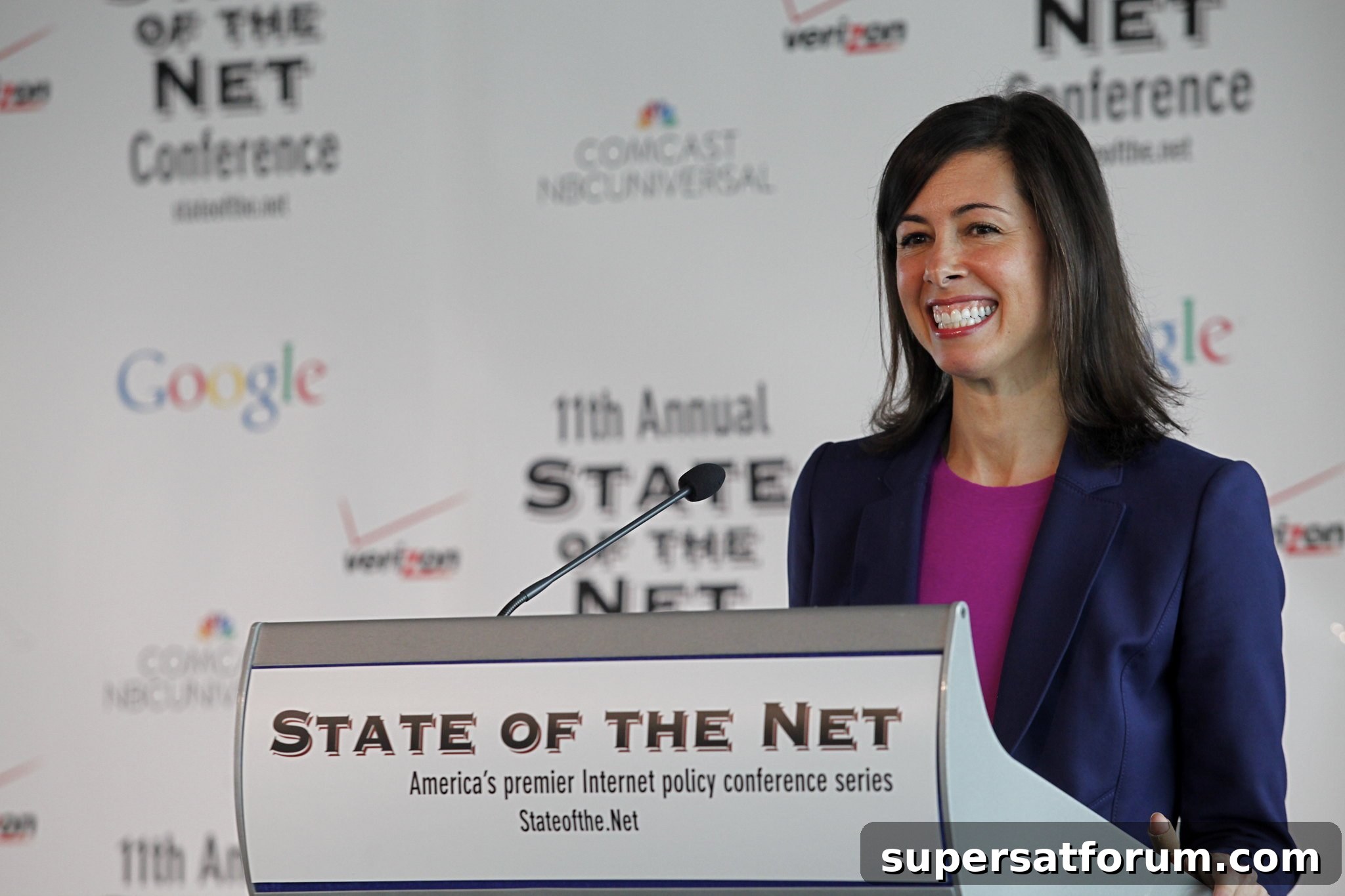
Democratic FCC Commissioner Jessica Rosenworcel has urged a review and potential repeal of a federal law that grants the president the authority to suspend communications, warning that the power could be misused and that U.S. law should be updated to prevent any possibility of communications shutdown on American soil.
Many Americans are unaware that existing federal statutes permit the president to intervene in communications operations during certain emergencies. While the statute in question is framed as a wartime measure, Rosenworcel and other policy experts argue that modern safeguards and clearer legal limits are needed to ensure such sweeping authority cannot be misapplied.
Rosenworcel raised the issue during her keynote address at the State of the Net conference in Washington, where she emphasized the importance of defending open access to the internet both at home and abroad. She noted that governments across the world have repeatedly shut down internet and communications services to control dissent or manage unrest, demonstrating the real-world harms that can follow when such powers exist without tight oversight.
She pointed to recent examples where governments curtailed connectivity: in November last year, Iran shut off internet access while clamping down on protesters; Cameroon has implemented repeated, lengthy shutdowns — one lasting more than 240 days; and in India, authorities cut communications in the disputed region of Kashmir for many months before partially restoring access. These incidents illustrate how internet shutdowns can be used to stifle speech and limit information flow.
“We need to update our laws too,” Rosenworcel told the conference audience. She specifically referenced 47 U.S.C. § 606, a provision that, as written, allows the president to “suspend or amend, for such time as he may see fit, the rules and regulations applicable to any or all stations or devices capable of emitting electromagnetic radiations.” Although intended as a wartime power, Rosenworcel argued that the statute’s broad language and lack of explicit judicial or congressional oversight creates potential for misuse.
The text of the statute remains available through official legal repositories for those who wish to read it in full. Critics point out that the provision’s sweeping wording — permitting suspension of communications-related regulations — could be interpreted in ways that allow major disruptions to public communications without immediate legal checks.
Harold Feld, Senior Vice President at Public Knowledge, echoed Rosenworcel’s concerns on social media, noting that while he typically finds alarmist claims overblown, Rosenworcel’s reasoned judgment on communications policy merits attention. Her call to reassess the statute has prompted renewed discussion among regulators, lawmakers, and civil liberties advocates about whether 47 U.S.C. § 606 remains appropriate in the modern era.
Those who defend retaining wartime provisions argue that such powers are necessary for national security during armed conflict. However, even supporters acknowledge that clearer constraints, explicit triggers, and stronger oversight mechanisms — such as prompt congressional review and judicial oversight — would reduce the risk of overreach and better protect civil liberties.
Rosenworcel’s proposal does not suggest immediate abolition of all emergency authorities related to communications. Instead, she advocates for a careful legislative update: remove or narrowly tailor outdated statutory language, define the precise circumstances under which any emergency suspension might be used, and build in transparent review processes so any extraordinary actions face prompt legal and democratic scrutiny. For many observers, that balance — preserving legitimate national security tools while preventing abuse — is essential.
The debate over 47 U.S.C. § 606 dovetails with broader conversations about digital rights, national security, and emergency powers in the internet age. As more of daily life and critical infrastructure relies on continuous connectivity, the stakes for any government-imposed communications interruption are much higher than when the law was first enacted. Advocates for reform emphasize that even if the immediate risk of a U.S. government–ordered shutdown seems remote, removing or clarifying antiquated authorities would strengthen democratic safeguards and signal a commitment to protecting free expression and access to information.
Rosenworcel also used her platform to call on the United States to speak out against foreign regimes that cut off internet access in order to suppress dissent, arguing that defending an open internet abroad complements efforts to ensure legal protections at home. Addressing international abuses, she said, highlights the real harms shutdowns cause to human rights, economic activity, and public safety.
Public discussion of the issue has already started to spur questions in Congress and among civil society groups about whether lawmakers should amend or repeal the relevant wartime communications provisions. Any legislative change would need to balance national security needs with constitutional protections, and would likely involve careful drafting to specify emergency conditions, oversight mechanisms, and sunset provisions to prevent indefinite or unchecked authority.
Image Credit: FCC Commissioner Jessica Rosenworcel (Internet Education Foundation) under CC BY-SA 2.0
Interested in hearing industry leaders discuss subjects like this and sharing their use-cases? Attend the co-located IoT Tech Expo, Blockchain Expo, AI & Big Data Expo, Cyber Security & Cloud Expo and 5G Expo World Series with upcoming events in Silicon Valley, London and Amsterdam to explore the future of enterprise technology.