Over the last decade, digital technology has deeply reshaped the automotive industry, altering how vehicles are designed, manufactured, and operated. These advances are transforming transportation into an interconnected system where data, connectivity, and software are central to safety, efficiency, and sustainability.
Among the new technologies, 5G stands out for its potential to enable safer, less stressful, and lower-emission driving. By combining ultra-low latency, greater reliability, and advanced networking capabilities, 5G can support features and services that improve road safety, reduce accidents, and scale mobility ecosystems across cities and regions.
Historically, digital automotive development focused primarily on safety—reducing collisions and saving lives. For many years cars were treated as largely autonomous islands, equipped with onboard tools like GPS navigation and local maps to help drivers reach their destinations. Modern connected features extend that concept, enabling vehicles to interact with their environment rather than relying solely on internal sensors and stored data.
Beyond the familiar “smart” applications present in most vehicles today, a new generation of connected systems promises to overhaul traditional transport. Connected cars, intelligent bus stops, networked metro systems, and autonomous vehicles can collectively reshape mobility by sharing real-time information among vehicles, infrastructure, and city systems.
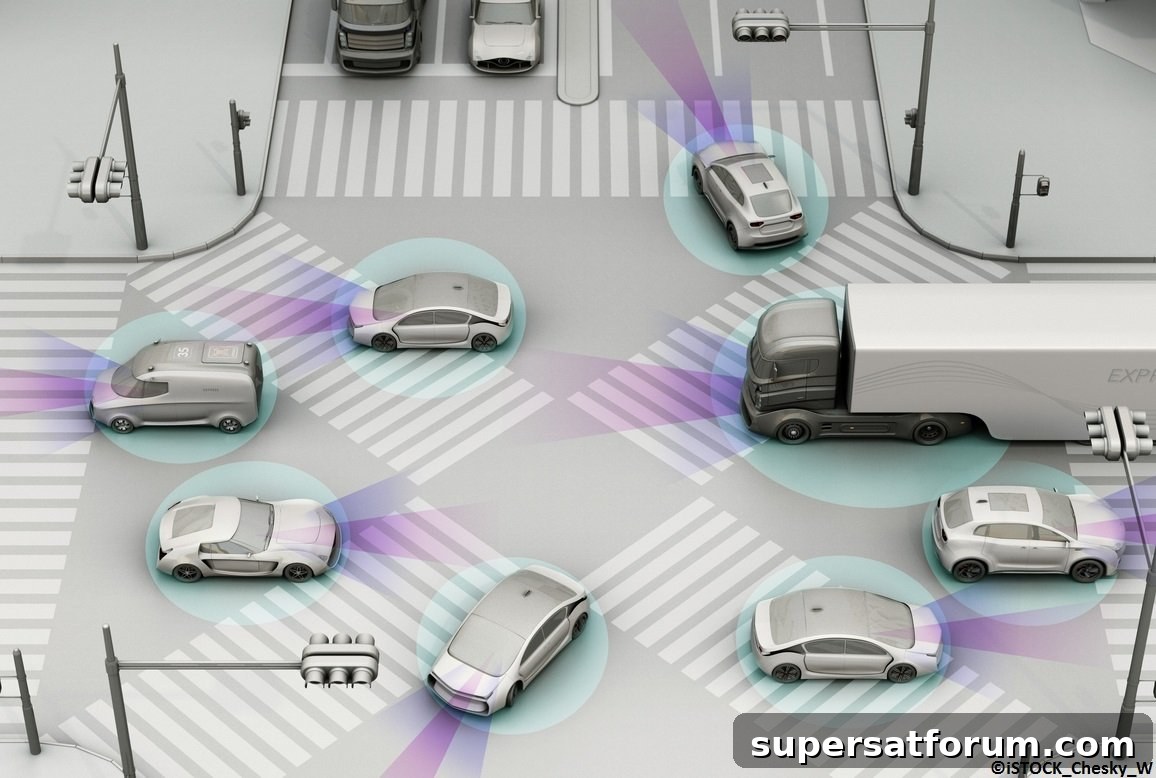
This shift requires rethinking cars as nodes in a broader, cooperative network rather than as isolated machines. Vehicles will gather and exchange real-time data with other cars, roadside sensors, traffic-management systems, and other elements of the transport ecosystem. Vehicle-to-vehicle (V2V) and vehicle-to-infrastructure (V2I) communication are key enablers for safer roads and more environmentally friendly traffic flow.
Until now, the lack of a reliable communications infrastructure has been a major obstacle to moving experimental technologies into mainstream automotive use. Although this challenge is not fully resolved, 5G technology offers the capabilities needed to overcome many current limitations. However, deploying a comprehensive 5G network suitable for automotive-grade applications will take several years and sustained investment.
It is also important to recognize that today’s advances rest on the foundation laid by 4G. While 4G cannot fully address extreme mobility scenarios in both dense urban centers and sparse rural areas, it enabled the first wave of connected vehicle services. With targeted technical improvements, 5G represents a significant step forward in digital infrastructure for transportation.
Release 16 from 3GPP—the global standards body for mobile communications—introduces features such as URLLC (Ultra Reliable Low Latency Communications). URLLC is designed to support critical industrial applications, including safety-critical automotive services that require consistent, millisecond-level responsiveness.
Beyond reliability and low latency, 5G brings additional capabilities especially relevant for connected vehicles. Edge computing will allow processing to occur closer to vehicles, enabling faster interactions without routing every task through distant data centers. This localized processing reduces response times and improves resilience for real-time driving applications.
Another important 5G innovation is network slicing, which creates multiple virtual networks over a single physical infrastructure. With network slicing, safety-critical services can be isolated and allocated dedicated communication and computing resources, ensuring predictable performance even when other services share the same network.
Automakers and telecom operators are actively testing applications that leverage these capabilities. In a 5G trial led by Vodafone in the Milan metropolitan area—where Politecnico di Milano participated as a key research partner—I had the opportunity to observe the maturity of both network and vehicle technologies firsthand. The trial demonstrated practical use cases and highlighted the readiness of several components for real-world deployment.
One notable test was connected automatic emergency braking. While automatic braking already exists in modern cars using onboard sensors, connectivity enables emergency braking in exceptional situations—such as at blind intersections—by sharing sensor information between approaching vehicles. This capability allows the system to detect hazards that an individual car’s sensors might miss.
Connected adaptive cruise control is another promising application. By communicating with nearby vehicles, the system adjusts speed smoothly to current traffic conditions, helping to prevent stop-and-go waves caused by sudden speed variations and improving traffic flow.
Within the broader ADAS (Advanced Driver Assistance Systems) family, several services benefit from connectivity. Examples include speed adaptation coordinated with real-time traffic light status and the ability to stream live camera feeds from nearby vehicles to enhance situational awareness and support safer maneuvering.
Moving these prototype applications into mass-market products will require coordinated effort from automakers, telecom operators, and regulators. Standardization, regulatory clarity, and aligned business models are essential to integrate connected mobility services safely and economically at scale.
A critical step forward will be building durable partnerships and regulatory frameworks that encourage investment and define responsibilities between service providers, vehicle manufacturers, and public authorities. When technical readiness aligns with favorable policy and commercial cooperation, connected and safer mobility systems enabled by 5G can achieve broad adoption.