China’s smartphone market has undergone a dramatic shift, with domestic manufacturers now dominating the world’s largest mobile market. For the first time in recent memory, Apple has been pushed out of mainland China’s top five smartphone vendors.
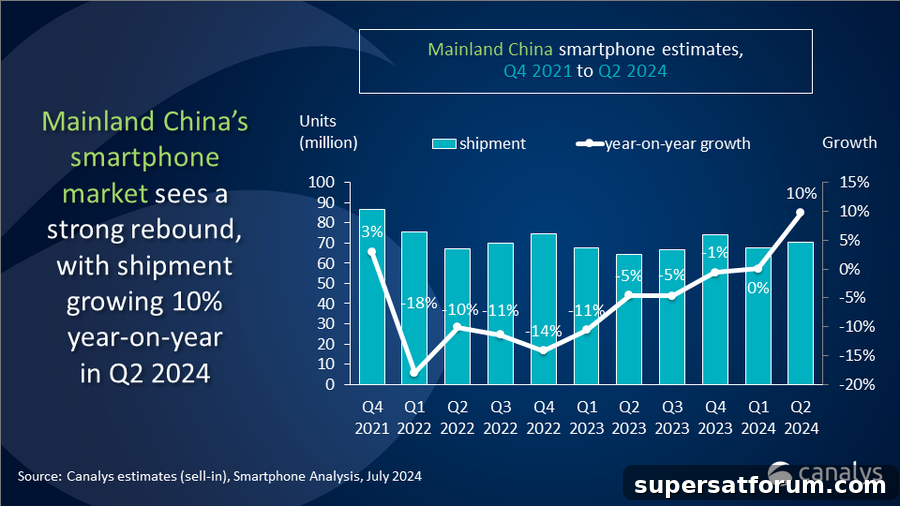
According to the latest report from market research firm Canalys, Chinese brands captured all five leading positions in Q2 2024. The market showed signs of recovery, expanding 10% year-on-year (YoY) in the quarter as shipments topped 70 million units—an encouraging indicator that China is aligning with the broader global recovery in smartphone demand.
Vivo leads as domestic brands surge
Vivo reclaimed the top spot with a 19% market share and 13.1 million units shipped, marking an impressive 15% YoY increase. The company benefited from strong offline channel performance and robust online sales during China’s major mid-year shopping festival, the “618” e-commerce event.
OPPO took second place with 11.3 million units shipped, translating to a 16% market share. Its performance was strengthened by the launch of the Reno 12 series. HONOR remained in the top three, shipping 10.7 million units—a 4% YoY rise—and holding roughly 15% of the market for the quarter.
Huawei’s comeback and Xiaomi’s return
Huawei staged an impressive return to fourth place with 10.6 million units shipped, delivering a striking 41% YoY increase. While growth eased slightly compared with prior quarters, Huawei’s resurgence is notable given the hurdles it has faced under US trade restrictions.
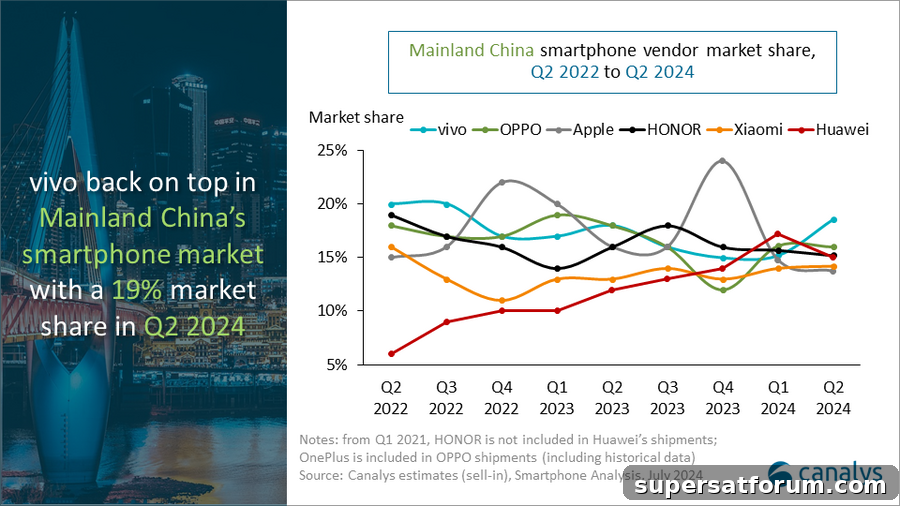
Xiaomi rounded out the top five with 10 million units shipped and a 17% YoY gain. The company capitalized on crossover momentum from its entry into electric vehicles—most visibly with the SU7—and consumer interest in its K70 and flagship 14 series phones.
Apple’s unexpected decline
Apple’s drop out of the top five is the most notable development in the Q2 figures. The iPhone maker fell to sixth place with a 14% market share, down 2 percentage points year-on-year. Canalys analyst Lucas Zhong said Apple is encountering a bottleneck in mainland China, noting that the company’s channel strategy is focused on maintaining healthier inventory levels to stabilise retail prices and protect channel margins.
Market dynamics and outlook
The sweep of top positions by Chinese brands underscores local manufacturers’ increasing competitiveness and their deep understanding of domestic consumer preferences. Canalys Research Manager Amber Liu observed that the market’s recovery was largely supply-driven and accelerated by nationwide sales events like “618.”
Liu also highlighted that vendors with broad smart device ecosystems, such as Huawei and Xiaomi, are strengthening their offline channel advantages by expanding partner networks and promoting up-sell and cross-sell opportunities across their product lines.
Looking forward, Canalys Senior Analyst Toby Zhu expects a modest, single-digit recovery for the full year despite the strong Q2 performance. He identified three major trends likely to shape the market in the second half of 2024:
- The rollout of Huawei’s HarmonyOS Next as an effort to establish a third major mobile OS alongside Android and iOS.
- Greater investment in AI infrastructure by local players, including development of in-house models and AI-driven applications to differentiate offerings.
- Intensified overseas expansion by Chinese brands as they seek growth beyond an increasingly competitive domestic market.
These dynamics present both challenges and opportunities for international and domestic players alike. As Chinese manufacturers continue to innovate and expand their market share, global firms such as Apple will likely need to reassess strategies to sustain their positions in this pivotal market. The coming months will reveal whether Q2’s results mark a temporary fluctuation or a lasting realignment in China’s smartphone landscape.

Unified Communications is a two-day event held in California, London, and Amsterdam that explores the future of workplace collaboration in a digital world. The event is co-located with several technology conferences covering digital transformation, IoT, edge computing, intelligent automation, AI and big data, and cybersecurity and cloud technologies.