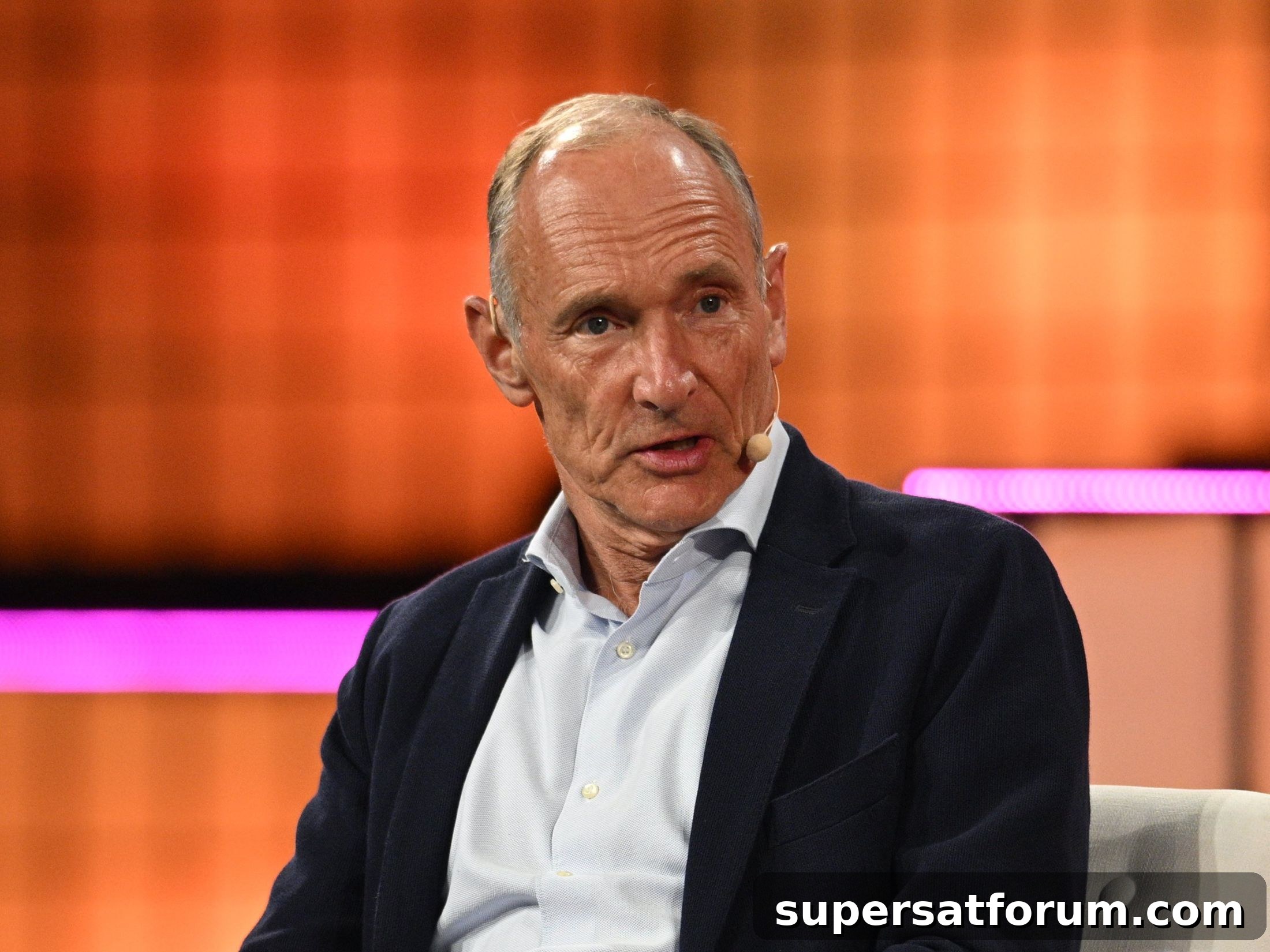
World Wide Web inventor Sir Tim Berners-Lee warns that the web has drifted from its founding principles and is no longer the open, free platform he intended.
In a recent piece for The Guardian, Berners-Lee reflects on how the web evolved from a collaborative, creative space into an environment dominated by a handful of powerful platforms that monetize user data. He argues that while the web has strayed, it is not too late to restore its original vision.
The web’s free and open origins
Berners-Lee recounts how, at 34 and working at CERN, he proposed combining the internet with hypertext — creating documents enlivened by clickable links — to enable global collaboration and creativity. His managers thought the idea “a little eccentric,” but he was eventually given the space to develop it.
His guiding principle was simple: if anyone could publish anything, over time the web would contain everything. For that to happen, access had to be universal and free of financial barriers.
That conviction led to a pivotal decision in 1993, when Berners-Lee persuaded CERN to release the World Wide Web’s intellectual property into the public domain. In his words, “we gave the web away to everyone.”
More than three decades later, he asks whether the web remains free. His answer is clear: it does not.
Berners-Lee says the Web 2.0 model concentrated power in the hands of a few large companies that extract vast quantities of personal data and monetize it. On these platforms, users are rarely treated as customers; they have become the product.
Personal information is routinely collected and sold to brokers, advertisers, and sometimes governments, often without users grasping the full implications. That data-for-service exchange fuels algorithms engineered to maximize engagement and, in many cases, addict users — a phenomenon Berners-Lee highlights as especially harmful for young people’s mental health.
He argues this business model also amplifies misinformation and other harmful content, undermining social cohesion and sometimes contributing to real-world harm — a stark departure from his initial hopes for an open, cooperative web.
Reclaiming data sovereignty with Solid
Despite his concerns, Berners-Lee remains hopeful and is actively working on a technical alternative. He points to Solid, an open-source standard developed by him and his team at MIT more than a decade ago. Solid is designed to change how data, users, and applications interact.
Solid gives each person a personal online data store, or “pod.” Instead of applications owning the data generated on their platforms, they must request access to a user’s pod. Individuals control what they share and with whom. Data lives under the user’s authority in a single location, rather than being scattered across multiple corporate silos.
“You generate all this data — your actions, your choices, your body, your preferences, your decisions. You should own it. You should be empowered by it,” Berners-Lee says.
He questions why health metrics from a smartwatch, financial records from a bank, and social media posts are kept in separate, incompatible systems that the creator cannot easily access. Solid is his practical answer for returning control to individuals and advancing the open web ideal.
Applying lessons to the advancement of AI
Looking ahead, Berners-Lee warns that society faces another critical crossroads with the rise of artificial intelligence. He cautions against repeating the errors of social media’s development and urges that governance frameworks for AI be established promptly so regulators do not spend another decade catching up.
He revisits a 2017 thought experiment about a personal AI called “Charlie,” which would operate for an individual with professional and ethical duties comparable to those of doctors or lawyers. Berners-Lee asks why AI cannot be governed under similar rules to ensure it serves people rather than corporate interests.
The lesson of Web 2.0, he says, is that when monopolies control personal data, they accumulate disproportionate power. “We can’t let the same thing happen with AI,” he insists.
To prevent that outcome, Berners-Lee proposes a bold idea: an independent, nonprofit international research body for AI, modeled in spirit after institutions like CERN. The collaborative, publicly supported environment that produced the web allowed its creators to give it away to the world. He suggests a similar neutral structure could steer AI development toward public benefit rather than narrow commercial gains.
He notes that many emerging Web 3.0 initiatives also aim to revive the web’s founding ideals, using technologies such as blockchains and directed acyclic graphs (DAGs) to enhance individual data sovereignty. Decentralized autonomous organizations (DAOs) seek more transparent, equitable decision-making among stakeholders rather than centralized corporate control. Such projects reflect a desire to return the web to an open, user-centered platform.
Berners-Lee believes restoring the web as a tool for creativity and collaboration is still achievable. Doing so will require political will to implement effective regulation and global governance, but the technical solutions already exist. It is, he concludes, not too late to reclaim the web.
(Image credit: Web Summit under CC BY 2.0 license. Image has been cropped.)
See also: BritCard: The real obstacle for UK digital ID is a national trust deficit
Want to experience the full spectrum of enterprise technology innovation? Attend TechEx events in Amsterdam, California, and London to explore AI, Big Data, Cyber Security, IoT, Digital Transformation, Intelligent Automation, Edge Computing, and Data Centres. TechEx gathers industry leaders to share real-world use cases and deep insights.
Telecoms is published by TechForge Media. Explore other upcoming enterprise technology events and webinars through TechForge Media.