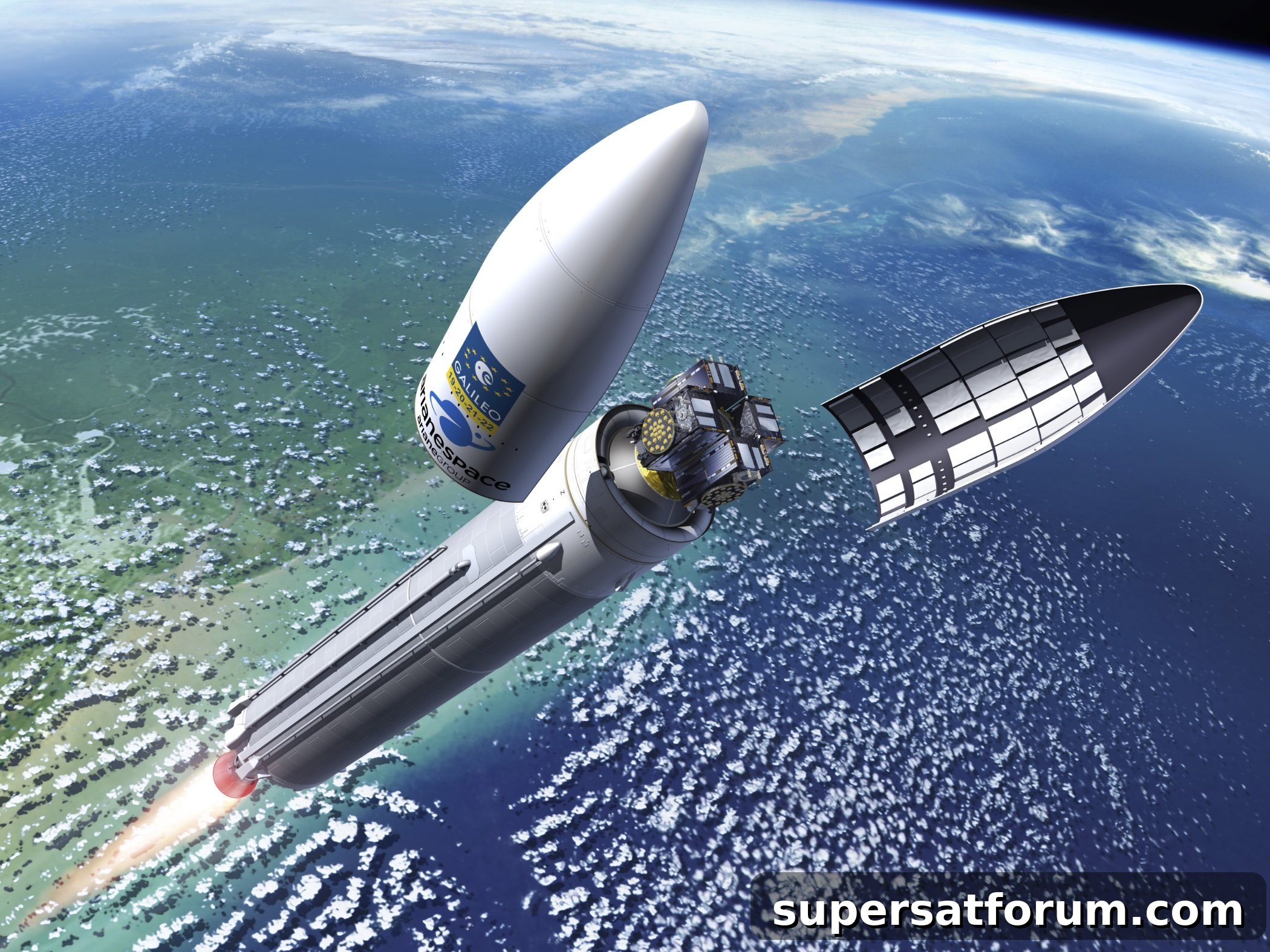
The European Space Agency (ESA) successfully launched two new Galileo navigation satellites over the weekend, further strengthening Europe’s satellite navigation capability.
The pair, the 27th and 28th satellites in the Galileo constellation, lifted off from Europe’s spaceport in French Guiana while many were enjoying a Sunday evening. The mission used a Soyuz four-stage launcher, one of the industry’s longest-serving launch vehicles, carrying a combined payload of roughly 1,645 kg.
Just in: gorgeous photo of this morning’s #Soyuz #VS26 launch, carrying European #Galileo satellites 27 and 28, 5 December 2021 👉https://t.co/iJioQSZ49A pic.twitter.com/JncojjJX5M
— European Space Agency (@esa) December 5, 2021
Paul Verhoef, ESA Director of Navigation, noted that this launch represents the 11th set of operational Galileo satellites placed into orbit over the past ten years. He highlighted that the constellation, which began initial services in 2016, has steadily matured into a reliable global navigation system. The additional satellites will improve the robustness of the network and allow higher service guarantees for users worldwide.
After separation, each satellite’s onboard electric thrusters will maneuver them into their operational medium Earth orbit at approximately 23,222 km above Earth.
Monitoring during the Launch and Early Orbit Phase (LEOP) and early operations is being handled by contractor Spaceopal from the Galileo Control Centre in Weßling, Germany. Spaceopal’s role ensures careful oversight during the sensitive initial commissioning period.
Work is also underway on second-generation Galileo satellites, which ESA describes as the most advanced, powerful and fully reconfigurable navigation spacecraft ever built. These next-generation satellites are planned to begin launching from 2024, offering improved resilience and new capabilities for the system.
Although the United Kingdom contributed significantly to Galileo’s development—supplying key components and investing around £1.2 billion—its participation became limited after Brexit. The EU treats Galileo as a security-sensitive program and reserves work for firms in its member states. Nonetheless, UK industry has retained close ties with ESA and European space projects in other areas.
Josef Aschbacher, ESA Director General, emphasized the value of UK expertise, calling the United Kingdom an important partner for ESA. Cooperation continues on civilian Earth-observation programs such as Copernicus, which monitors natural disasters, environmental change and pollution.
The New Space Race
International collaboration and commercial activity are driving a renewed push in space development. In mid-2020, the UK and the United States agreed to expand cooperation so US companies can export launch technology to the UK and operate from planned British spaceports. The move aims to accelerate the UK’s nascent launch sector and attract private investment.
Karen Pierce, UK Ambassador to the US, described the agreement as opening an exciting chapter in UK–US space collaboration. She highlighted the commercial space sector’s existing trade and jobs across both countries and predicted further economic growth from deeper cooperation.
As part of the UK government’s Spaceflight programme, nearly £40 million in grants have been awarded to support commercial vertical and horizontal small-satellite launches from British spaceports. Initial commercial launches were targeted for the early 2020s as the UK builds launch infrastructure and regulatory frameworks.
OneWeb, a London-based satellite communications company, has become a major player in the UK space sector. The UK government and partners acquired a majority stake in OneWeb, which has since attracted investment from several global firms and continued to expand its Low Earth Orbit (LEO) broadband constellation.
In August, OneWeb deployed another 34 LEO broadband satellites, and the company aimed to have more than 600 satellites in orbit to support global connectivity. OneWeb has pursued commercial partnerships, including a deal to provide LEO connectivity services to BT, and has explored ways to improve rural connectivity in the UK.
Business Secretary Kwasi Kwarteng praised the government’s investment in OneWeb as a strategic step toward making the UK a global science and technology hub. OneWeb has also been mentioned in the UK National Space Strategy as a potential future contributor to navigation services, with plans to demonstrate capabilities and work with UK bodies on possible navigation offerings.
Beyond investment, the UK’s space strategy emphasizes collaboration with like-minded partners. The “Five Eyes” intelligence partners—UK, US, Australia, Canada and New Zealand—are cited as natural allies for space ventures. At the same time, the ESA remains an important multilateral partner for the UK in civil science, exploration, climate monitoring and technical cooperation.
(Image Credit: ESA–Pierre Carril)
Looking to advance your digital transformation strategy? Discover insights at Digital Transformation Week, taking place on 11–12 May 2022, where industry leaders share practical approaches to drive successful digital initiatives.