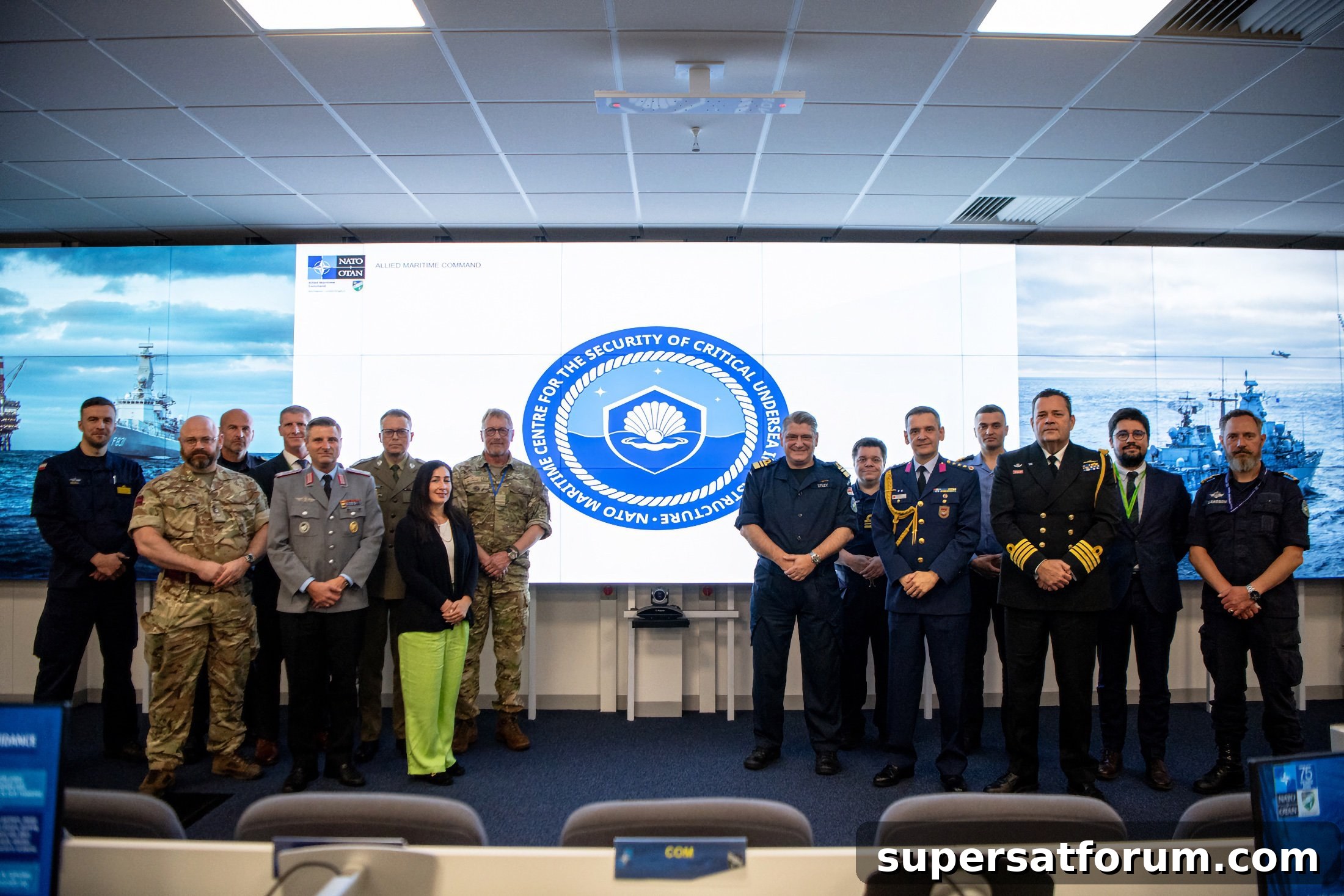
NATO has opened a specialised centre to protect critical undersea energy pipelines and communication cables—vital links for global communications, energy supply, and economic stability that remain vulnerable to deliberate damage or sabotage.
The NATO Maritime Centre for Security of Critical Undersea Infrastructure (CUI) is based at NATO Allied Maritime Command (MARCOM) in Northwood, UK. Now declared at Initial Operational Capability (IOC), the centre acts as a networking and knowledge hub to support Commander MARCOM in decision-making, force deployment and coordinated responses.
Royal Navy Vice Admiral Mike Utley, Commander MARCOM, said: “Securing CUI goes beyond posturing to deter future aggression; it requires robust coordination to actively monitor and counter malign or hybrid threats, denying any aggressor the cover of ‘plausible deniability’.
“Through the wide networks we are establishing in the new centre, that job will become much easier to achieve. And if, in the future, nations seek NATO assistance, we will be ready to help them using our networks and data.”
The centre serves as the operational hub at MARCOM while a strategic hub sits at NATO Headquarters in Brussels. This dual-hub arrangement is intended to strengthen cooperation among NATO allies, partner nations and the private sector. Civilian stakeholders emphasised their support: representatives from the Norwegian Oil Industry, Offshore Norge, gas transport operator Gassco AS and energy company Equinor ASA issued a joint statement highlighting the importance of cooperation between military and industry actors.
“It’s been a year of strong teamwork defining and establishing the centre here at MARCOM, and we are now seeing the results as we reach this important milestone,” said Danish Navy Captain Niels Markussen, Director of the NATO Shipping Centre.
“We’ve overcome many challenges to get here. Strong cooperation across MARCOM’s operations, intelligence, IT and Civil-Military Cooperation (CIMIC) has been key, and we’ve worked closely with NATO HQ, SHAPE, SACT and CMRE, as well as numerous civilian organisations.”
The formal launch follows NATO Headquarters hosting the inaugural meeting of NATO’s Critical Undersea Infrastructure Network, where senior experts exchanged information and shared expertise in response to evolving threats to CUI.
Professor James Bergeron, MARCOM’s Political Advisor, highlighted the centre’s role in surveillance and accountability.
“Protecting every inch of CUI is difficult,” Bergeron acknowledged. “What we can do is work to deny deniability. If an actor seeks to harass, undermine or clandestinely damage offshore or undersea infrastructure, our aim is to ensure they cannot escape responsibility.
“They will be detected: cameras will record activity, underwater sensors will monitor movements, and signals intelligence will create an evidentiary trail, making denial of responsibility far harder and enabling accountability.”
Allies agreed at the Vilnius Summit last year to establish the Maritime Centre for Security of Critical Undersea Infrastructure at MARCOM, a decision reaffirmed by Defence Ministers in February. Contributing nations currently include Denmark, Germany, Norway, Poland, Türkiye, the UK and the USA, with Greece, Portugal and Sweden expected to join soon.
The centre is a key element of NATO’s broader effort to safeguard critical undersea infrastructure. By improving coordination, leveraging partner networks and deploying advanced monitoring technologies, the alliance aims to protect these essential assets from hostile activity and to ensure that any attacks can be documented and attributed.
See also: BT highlights the role of satellites in future-proofing networks
Unified Communications is a two-day event held in California, London and Amsterdam that examines the future of workplace collaboration in a digital world. The event is co-located with Digital Transformation Week, IoT Tech Expo, Edge Computing Expo, Intelligent Automation, AI & Big Data Expo, and Cyber Security & Cloud Expo.
Explore other upcoming enterprise technology events and webinars powered by TechForge.