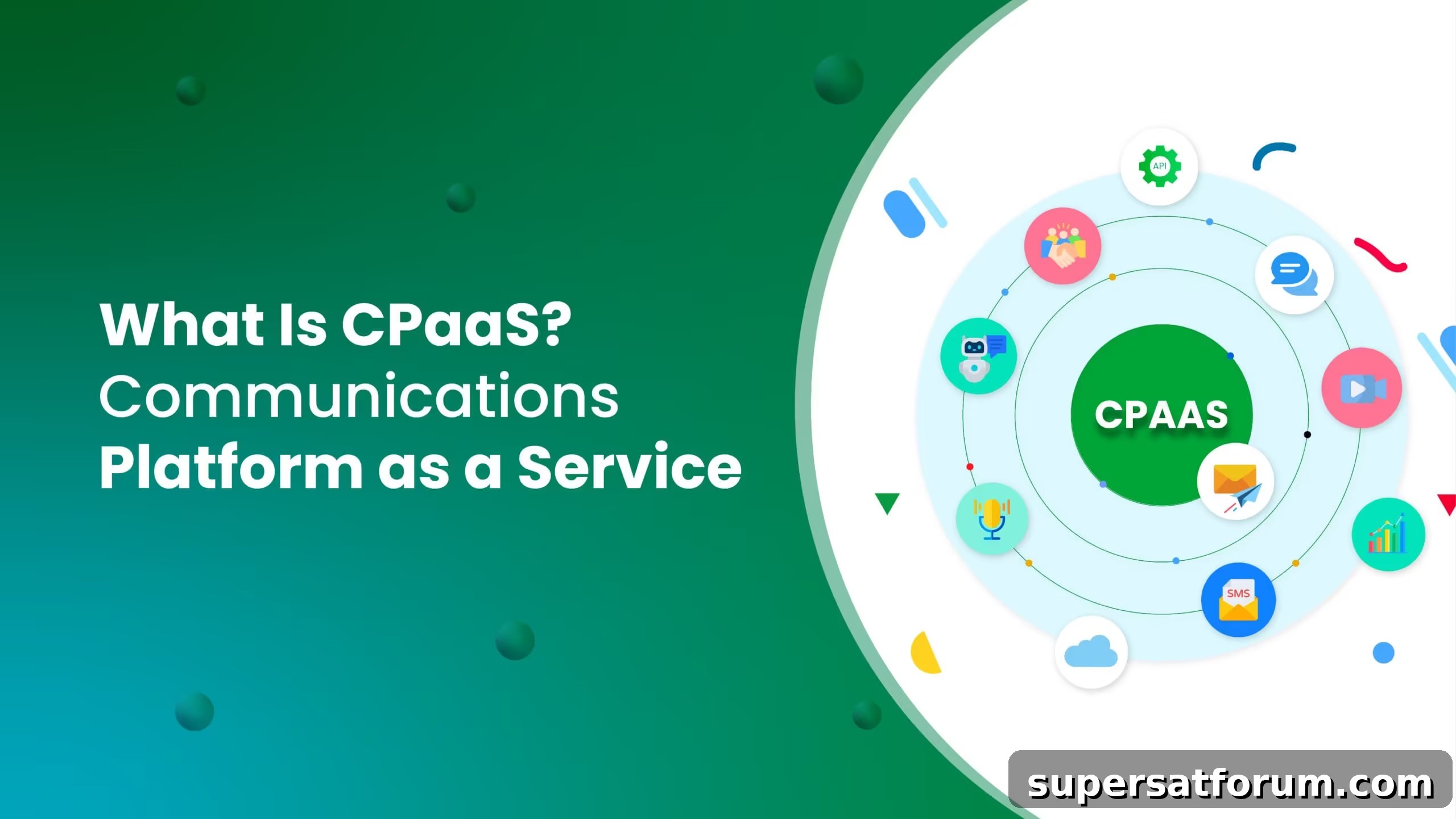
The communications industry is rapidly being transformed by Communications Platform as a Service (CPaaS). CPaaS enables services like video calls and two-factor authentication to be embedded directly into your existing application, seamlessly and in real time. These solutions do not require deep technical expertise, making CPaaS an excellent option for small businesses looking to modernize customer interactions, since it is a fully managed service. What is CPaaS, how does it help, and what are its advantages?
What is CPaaS?
CPaaS (Communication Platform as a Service) is a cloud-based offering that allows companies to add communication features—such as voice, video, messaging, and chat—into their applications. With CPaaS, businesses can improve customer interactions and team collaboration without relying on complex communication systems. It makes real-time communication across various channels—like phone calls and messages—easy to implement. CPaaS can reduce costs by removing the need for traditional communications infrastructure. It is a straightforward, flexible solution that helps organizations of all sizes improve communication processes and customer experience.
How does the communications platform work?
CPaaS is cloud-based and programmable, meaning services like video conferencing, SMS, and IVR are integrated into other applications through APIs without disrupting the primary application functions. This allows organizations to conduct internal communications and customer interactions directly within their own platforms, effectively eliminating the need for third-party tools.
Rather than designing and building a communications system from scratch, developers can use third-party CPaaS providers that supply extensive APIs, code libraries, and development kits. CPaaS is commonly offered on a subscription basis—companies pay only for the features they need.
Implementing CPaaS can be straightforward for small businesses: often it’s as simple as purchasing a service from a provider and integrating it with minimal technical assistance. Most CPaaS vendors provide ongoing technical support so you are not left to handle issues on your own.
Key benefits of CPaaS
CPaaS offers many advantages, making it a valuable investment:
- Improved customer service: By enabling real-time interactions, CPaaS simplifies customer support and helps companies respond immediately to customer needs without requiring them to leave the app.
- Seamless integration: CPaaS can be added to existing applications through APIs, preserving core app functionality while adding communication features.
- Customizable features: Whether you need video chat, SMS, or two-factor authentication, CPaaS lets you select only the features your business requires.
- Scalability: CPaaS grows with your business. Additional capabilities can be added easily when needed, making it adaptable to changing requirements.
- Cost savings: As a cloud service, CPaaS typically offers predictable monthly pricing that reflects only the features you choose, reducing the expense tied to custom-built communication systems.
CPaaS versus UCaaS
| Characteristic | CPaaS (Communications Platform as a Service) | UCaaS (Unified Communications as a Service) |
|---|---|---|
| Focus | Adds communication capabilities (voice, video, chat) to existing apps or websites | Provides a complete communications platform (phone system, video calls, messaging, etc.) |
| Customization | Highly customizable; pick and integrate only the needed functions | Less customizable; features are bundled into a single unified platform |
| How it works | Developers use APIs to embed communication features into existing software | Access a single, standalone platform for all communication needs |
| Best for | Companies that want to enhance their own apps with real-time communication features | Organizations that need an all-in-one communications solution for internal teams |
| Solution type | Modular add-on for existing applications | Comprehensive, ready-to-use solution for team communication |
| Integration | Seamless integration into existing apps via APIs | No integration required; a separate platform for all communications |
Why choose Salestown’s CPaaS solutions?
Salestown positions itself as a leading provider of CPaaS solutions, offering a powerful platform and services used by small, medium, and large organizations. Key reasons Salestown stands out include:
- Comprehensive features
Salestown’s CPaaS platform includes the full range of connectivity options companies need—SMS, voice, video, and chat. - User-friendly APIs
Salestown provides intuitive APIs that make it easy to build and integrate communication features into existing systems. - Scalable infrastructure
The platform supports everyone from startups to large enterprises, offering virtually limitless scalability. - Reliable performance
Salestown’s robust frameworks ensure high availability and dependability, essential for real-time connectivity. - Data security
Data protection is a top priority, and Salestown applies industry-standard security measures to keep your information safe.
Advantages of CPaaS (communications platform)
Communications Platform as a Service (CPaaS) represents a new class of solutions that connects customers and businesses while addressing communication goals, costs, and outcomes. Below are some of the main advantages of adopting CPaaS:
1. Flexibility: A major strength of CPaaS is its flexibility. It enables businesses to add voice, video, messaging, or chat to their applications without building complex infrastructures. This flexibility lets organizations selectively adopt the communication capabilities they find most useful and reuse them as needed. Whether for a small business or a large enterprise, having a solution that can adapt to specific communication needs is crucial—and CPaaS fulfills that role.
2. Easy to scale: CPaaS platforms are designed to scale. As your business grows, you can add more communication capabilities, reach more customers, or expand into new markets without major structural changes. This is especially valuable for companies that cannot predict growth or how they will respond to new opportunities. With CPaaS you pay only for what you need and adopt additional services as you expand.
3. Modern technology: CPaaS equips organizations with communication solutions that meet current and future consumer expectations. Real-time messaging, omnichannel support, and automated responses help companies stay relevant with cutting-edge capabilities. CPaaS also integrates emerging technologies—such as AI and machine learning—to improve process efficiency and the customer experience.
4. Ease of use: Despite offering powerful capabilities, CPaaS platforms remain straightforward in their design. They provide simple interfaces, APIs, and templates to help organizations integrate and migrate communication solutions without heavy developer involvement. This accessibility makes CPaaS suitable for organizations of all sizes and technical skill levels.