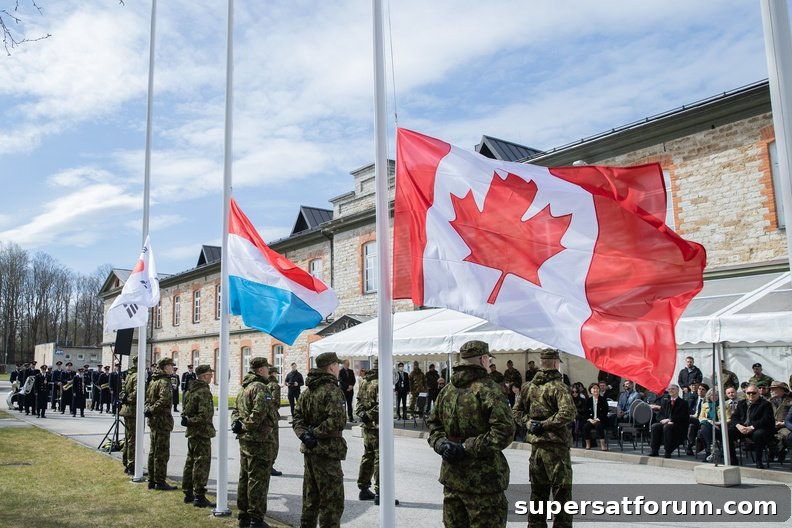
The NATO Cooperative Cyber Defence Centre of Excellence (CCDCOE) held a flag-raising ceremony this week to welcome three new members: the Republic of Korea, Canada, and Luxembourg. The event marks an expansion of the centre’s international cooperation in cyber defence and intelligence sharing.
Colonel Jaak Tarien, Head of the CCDCOE, emphasized the significance of the accession: “It is a great honour to have Canada, Republic of Korea and Luxembourg in our growing and diverse family of like-minded nations. Each member of the CCDCOE plays an important role in building and advancing a strong and efficient unity against cyber threats. In the long run, the conditions for peace in the cyber realm and a response to the security threats to the modern world cannot be created without united and committed support.”
South Korea’s membership is especially notable as the CCDCOE’s first partner from Asia, underlining the centre’s increasingly global reach. Sun Hee Kim, representing the National Intelligence Service of the Republic of Korea, said the ceremony highlights the importance of international partnerships to address growing threats in cyberspace.
The rise in cyberattacks since Russia’s invasion of Ukraine has underscored the need for coordinated international defences. State-sponsored groups and affiliated actors have launched numerous operations that targeted government and military institutions as well as critical infrastructure sectors. Microsoft reported that hundreds of cyber operations have been directed at Ukraine, noting that more than 40% of destructive attacks targeted organizations in critical infrastructure sectors with potential negative second-order effects on government, military, economy, and civilians.
Kevin Rex, Canada’s Ambassador to Latvia, Estonia and Lithuania, reaffirmed Canada’s commitment to NATO and to strengthening allied cyber resilience: “Canada’s commitment to NATO is absolute. Our presence in the Baltics is our largest anywhere in the world. We are over 1,400 boots-on-the-ground in the Baltics anchored in our leadership of NATO’s Enhanced Forward Presence Battle Group in Latvia. Today, we are pleased to formally join the CCDCOE and contribute to strengthening Allied capacity to respond to evolving threats to our democracies taking place in the cyber realm, including as part of Russia’s unprovoked aggression against Ukraine.”
Earlier advisories from members of the Five Eyes intelligence alliance also warned of increased Russian cyber activity against critical infrastructure, particularly targeting countries that have supported Ukraine. These warnings stressed that nations providing military or other aid could become targets for disruptive or destructive cyber operations.
Representatives from Luxembourg stressed the value their country places on collaboration and expertise-sharing. A spokesperson for the Embassy of the Grand Duchy of Luxembourg said, “Cooperation, sharing of information, skills, and best practices are essential for tackling the challenges we face in cyberspace. Luxembourg is convinced that the expertise of the CCDCOE will strengthen its cyber defence efforts and we are committed to contributing our own experience.”
With the addition of these three countries, CCDCOE’s membership now totals 32. Of those, 27 are full NATO members and five are partner contributors that are not formal NATO members. In March, CCDCOE also voted to accept Ukraine as a contributing nation, reflecting the centre’s role as a hub for allied cyber defence collaboration and capacity building.
(Image Credit: CCDCOE)
Related: Cloudflare mitigated a 15 million requests-per-second DDoS attack.
Want to learn more about cybersecurity and the cloud from industry leaders? Attend Cyber Security & Cloud Expo events held in Amsterdam, California and London.
Explore other upcoming enterprise technology events and webinars powered by TechForge.