Enterprise Application Integration – An Introduction
Enterprise Application Integration (EAI) describes the methods and technologies used to connect disparate software applications so that data and business processes can flow smoothly across an organization. Beyond simple data transfer, EAI provides middleware and interfaces that orchestrate, transform, and manage exchanges between systems. In essence, EAI is an integration framework made up of tools, services, and architectural patterns that enable systems and applications across an enterprise to interoperate.
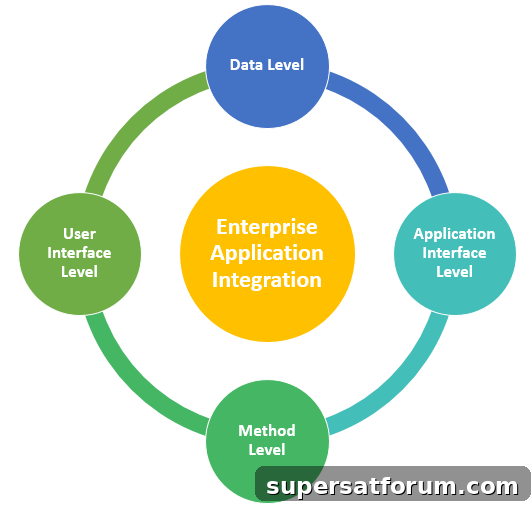
When implemented correctly, EAI helps organizations realize the full value of their software investments by enabling applications to share data and business logic. Typical EAI scenarios focus on connecting internal systems—such as finance, enterprise resource planning (ERP), customer relationship management (CRM), and legacy mainframe systems—with each other and with external transactional or e-business platforms. EAI implementations are commonly organized across four logical levels that address connectivity, mediation, orchestration and management.
Advantages of Enterprise Application Integration
-
Eliminates error-prone manual processes such as re-entering order data from e-commerce or transactional systems into internal financial systems, improving accuracy and speed.
-
Extends the life and value of essential but older applications by integrating them with modern systems, avoiding costly and risky rewrites.
-
Speeds integration of systems for acquired businesses or new divisions, simplifying the post-merger harmonization of IT landscapes.
-
Enables streamlined sales, manufacturing and distribution processes by wrapping transactional e-business front ends around existing back-end applications.
Tips: Enterprise Application Integration
Demand for EAI continues to grow as organizations standardize on configurable solutions that minimize custom coding. Companies increasingly favor specialized, configurable platforms (ERP, CRM, ECM) that can be adapted without heavy development. Common target areas for EAI projects include:
-
Supply chain management (SCM)
-
Customer relationship management (CRM)
-
Business intelligence and analytics
-
Human resources data
-
Internal and marketing communications
-
Enterprise resource planning (ERP)
-
E-commerce optimization
While a small number of enterprise vendors provide platform solutions, no single product automates every business process perfectly. As organizations automate more processes, the number of systems grows and integration complexity increases, making deliberate planning and governance essential.
An Analysis: How Companies Integrate Applications and Potential Problems
POINT-TO-POINT INTEGRATION
Point-to-point integration connects each application directly to another using individual links. Its primary appeal is simplicity—initially this approach looks straightforward. The downside is that each connection embeds its own logic and mapping. As the number of applications grows, the network of connections becomes difficult to maintain, creating operational, consistency and security challenges and requiring significant IT effort to support.
MIDDLEWARE
To address point-to-point complexity, organizations often introduce centralized middleware. While this is a logical step in architectural evolution, projects can stall when planning and design are incomplete. Different teams may take divergent approaches to flexibility and extensibility, and projects can underestimate the ongoing coding required for new applications or changing business processes.
If monitoring, persistence and transactional guarantees are not planned and implemented from the start, the result can be data loss, maintenance burdens and, in some cases, abandoned projects.
INTEGRATION PLATFORMS
Modern integration platforms—often built around Enterprise Service Bus (ESB) principles—enable teams to focus on business processes rather than low-level technical integration. These platforms reduce the risk and complexity associated with custom-built systems by providing reusable components, standard connectors and patterns.
Integration platforms typically include graphical process design tools, simulation, debugging and analysis capabilities, reliable transport mechanisms, logging and monitoring, security features, and scalability and extensibility options that production environments require.
EAI Mistakes and How to Avoid Them
Despite best practices, EAI initiatives can fail when common anti-patterns are followed. Awareness of these pitfalls and proactive mitigation increases the odds of success. Common mistakes include:
-
Trying to piece together disparate systems rather than designing a unified integration approach.
Start with business strategy. Treat existing information systems as modular building blocks and design integration around business outcomes rather than just linking systems together.
-
Expecting EAI to solve all IT problems.
EAI supports enterprise architecture and business processes but is not a magic cure for every IT issue. Focus on business-driven goals and use EAI to enable those priorities.
-
Building or emulating unnecessary features.
Prioritize projects that deliver a clear return on investment and ensure the integration work can be put into production within a realistic timeframe.
-
Over-engineering by decomposing applications into unnecessary granular pieces and then trying to reintegrate them.
Complexity is inherent in integration projects. Avoid creating needless fragmentation that increases development and maintenance cost and introduces future points of failure.
-
Turning the EAI layer into an enterprise data warehouse or master repository.
Separate integration logic from data management. Use dedicated Master Data Management (MDM) and data governance solutions to handle master and reference data, and keep EAI focused on message routing, transformation and process orchestration.
Synopsis
Enterprise Application Integration enables automation of business processes by synchronizing tasks and resources across systems and people. A well-designed integration layer often operates invisibly to end users and business operators, yet it represents a critical potential point of failure if not built and managed carefully. Plan integration projects with attention to security, scalability, reliability and availability. Treat EAI as a strategic component of your IT roadmap to support business agility and long-term growth.