NEC has developed and demonstrated a radio-over-fibre system using a 1-bit fibre transmission technique. This innovation could make it economically feasible to deploy stable millimetre-wave communication networks for “Beyond 5G” (B5G) and future mobile generations.
The 1-bit approach enables high-frequency analog signals to be sent over fibre using inexpensive electrical-to-optical converters designed for general-purpose digital communications. By doing so, NEC can produce compact, low-cost distributed antenna units (DAs) suitable for dense indoor and urban deployments.
“As a result, a stable millimetre-wave communication environment can be achieved affordably in high-rise buildings, underground malls, factories, railways, indoor facilities, and other areas with many obstacles,” NEC said in its announcement.
Millimetre-wave technology is expected to play a central role in future high-speed wireless networks. Because roughly 80 percent of mobile traffic originates indoors, millimetre-wave solutions are being investigated to boost indoor capacity and performance.
However, millimetre-wave signals suffer significant propagation loss and demand high linearity. Maintaining line-of-sight between base stations and user devices is often necessary to deliver acceptable quality of service.
One effective way to address these limitations is to deploy many distributed antenna units so that devices communicate directly with nearby antennas without obstruction. Until now, the size, power consumption, and cost of placing enough DAs have been major obstacles.
NEC’s new radio-over-fibre (RoF) system coupled with the 1-bit transmission method is designed to overcome those challenges.
Analogue and digital RoF: Combining the strengths of both
Traditional RoF systems fall into two categories: digital and analogue. In digital RoF, the radio unit sends digital baseband signals over fibre to the distributed antenna. Each antenna therefore needs a digital signal processor (DSP) and a digital-to-analog converter (DAC), which increases power consumption and cost.
Analogue RoF, by contrast, generates the high-frequency analog RF signal at the radio unit and transmits it over fibre directly to the antenna. This simplifies the antenna design by eliminating the need for a DSP and DAC, but requires expensive, highly linear analogue optical modulators.
NEC’s 1-bit fibre transmission method converts high-frequency analog signals into 1-bit pulse streams that travel over the fibre. At the antenna, appropriate filtering reconstructs the desired analog waveform.
“With 1-bit RoF, affordable, general-purpose electrical-to-optical converters used in digital communications can be employed, as in digital RoF,” NEC explains. “At the same time, like analogue RoF, the distributed antenna does not require onboard DSP or DAC.”
“Consequently, 1-bit RoF merges the advantages of both digital and analogue RoF approaches.”
The key technical hurdle was producing a modulator that converts analog waveforms into 1-bit pulse signals with a high signal-to-noise-and-distortion ratio. For downlink transmission, NEC developed a “vector decomposition method” to perform this conversion while preserving signal quality.
For uplink traffic, NEC introduced a “digital reproduction method” that cancels distortion introduced by 1-bit conversion and regenerates the original uplink signal, reducing performance degradation in both directions.
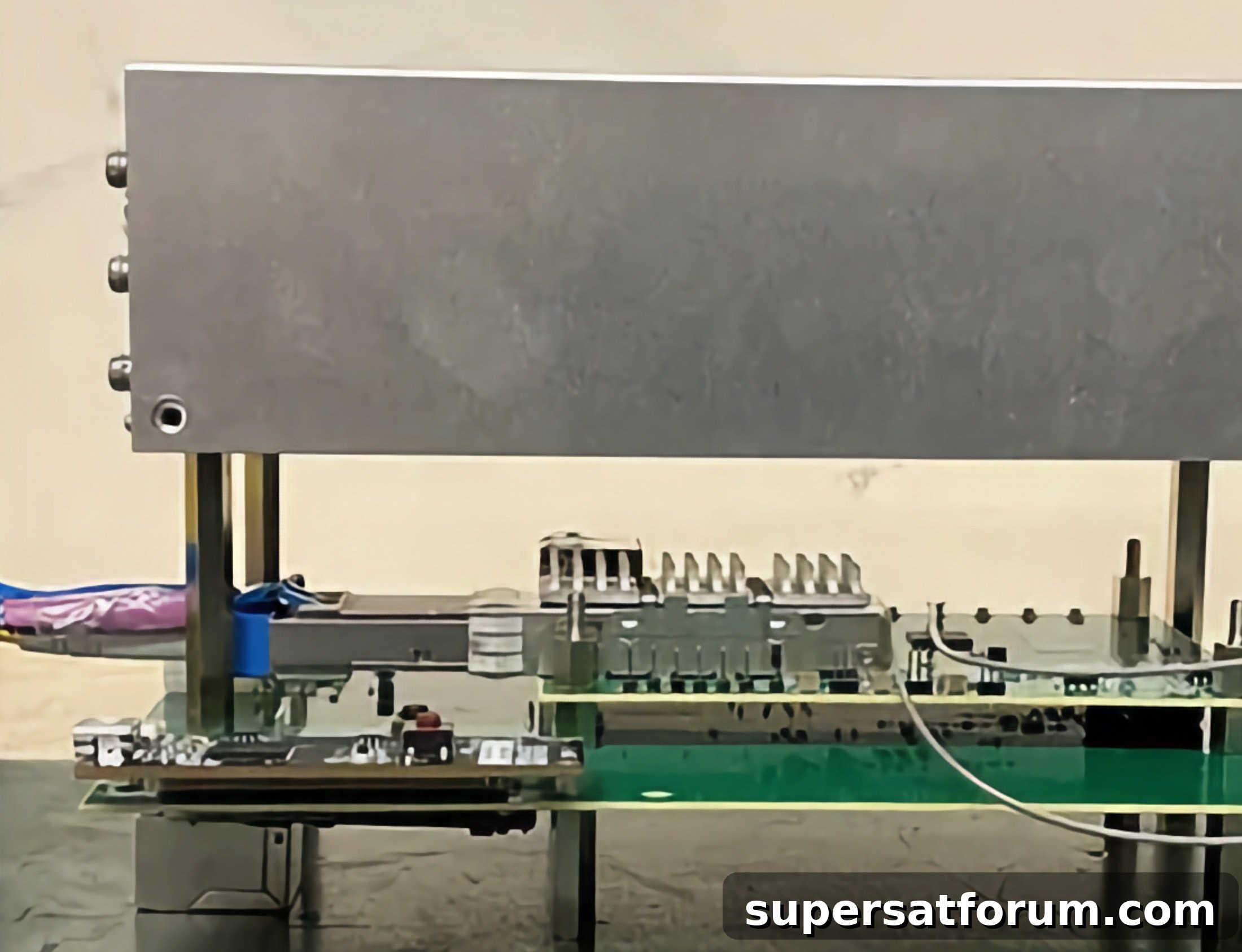
NEC built a prototype 1-bit RoF system operating in the 40 GHz band, consisting of a radio unit and compact distributed antennas. Tests confirmed compliance with mobile communication standards.
“The newly developed system enables compact, low-cost DAs to be installed at high density,” NEC said. “It is expected to improve the millimetre-wave communication environment by ensuring line-of-sight between distributed antennas and terminals.”
By combining 1-bit transmission with RoF technology, NEC’s system aims to make stable millimetre-wave networks economically viable in environments such as high-rise buildings, shopping centers, factories, and rail systems.
“This approach will help accelerate the adoption of high-speed, large-capacity millimetre-wave communications for Beyond 5G and 6G,” NEC stated.
NEC also noted it will continue developing high-speed, high-capacity technologies as network operators explore millimetre-wave and other spectrum bands to expand bandwidth for future 6G services.
(Image Credit: NEC)
See also: Nokia unveils world’s first immersive voice and audio call technology
Unified Communications is a two-day event held in California, London, and Amsterdam that explores the future of workplace collaboration in a digital world. The event is co-located with several technology conferences covering digital transformation, IoT, edge computing, intelligent automation, AI and big data, and cybersecurity.
Discover other upcoming enterprise technology events and webinars powered by TechForge.