(Image Credit: iStockPhoto/scyther5)
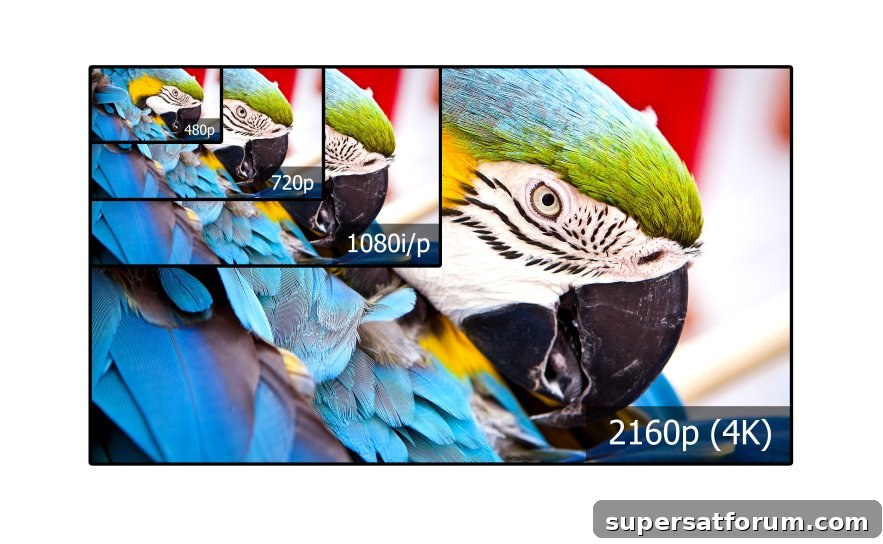
As hardware prices fall and more content becomes available, 4K adoption is beginning to grow. With over four times the pixels of Full HD, Ultra HD delivers noticeably sharper and more detailed images. While streaming services such as Netflix provide much 4K content over the internet, a significant number of viewers still rely on over-the-air broadcast television.
LG has announced over-the-air field tests of 4K broadcasts using the ATSC 3.0 standard. Operating under an experimental license for a 6 MHz channel granted by the FCC, tests conducted in Cleveland since mid-May use a transmitter supplied by Tribune Broadcasting’s WJW-TV.
John Cifani, chief engineer at WJW-TV, said they were glad to contribute to the evolution of broadcast technology by using an unused transmitter and vacant channel to test the proposed transmission system around the clock. He added that the initial field test results show ATSC 3.0 technologies are real and provide tangible benefits to both broadcasters and viewers.
Marketed as “Futurecast,” the collaborative effort between LG, GatesAir, and Zenith aims to develop next-generation ATSC 3.0 broadcast technology, which is being standardized by the Advanced Television Systems Committee.
Field test results show that our ATSC 3.0-enabling technology performs exactly as expected.
Early results are encouraging. Engineers collected 75,000 data points across the North Coast region, demonstrating that the current ATSC 3.0 implementation can transmit 4K Ultra HD content plus two resilient mobile TV streams within a single 6 MHz channel. The tests also indicated improved indoor reception and greater spectrum efficiency.
The standard performed well across diverse conditions—from fast-moving vehicles to a range of locations including dense urban “concrete canyons,” suburban neighborhoods, and rural areas up to 50 miles from the transmitter.
Dr. Skott Ahn, President and Chief Technology Officer at LG Electronics, said their technology is designed to meet broadcasters’ ATSC 3.0 requirements and to accelerate the transition to next-generation broadcasting. He noted that whether viewers are deep inside buildings or along the Lake Erie shore, field tests confirm the technology performs as intended.
Key benefits of ATSC 3.0 technologies include:
- Higher data throughput—up to around 30% increases—and improved handling of multipath interference versus the current DTV standard, enhancing fixed and portable TV reception;
- Better indoor signal penetration for mobile reception through flexible system parameter choices;
- Advanced transmission modes that support both very high data rates and highly robust signal delivery;
- Modern error correction coding and signal constellation methods to boost reliability;
- Future Extension Frames that enable the system’s evolution and support future broadcast enhancements;
- Improved single-frequency network capabilities for more efficient use of spectrum.
ATSC 3.0 also offers important improvements for emergency broadcasting. It can work with AWARN (the Advanced Warning and Response Network) to deliver rich-media emergency alerts—maps, graphics, video, text, and audio—to televisions and mobile devices, potentially improving public safety communications.
Do you think ATSC 3.0 will accelerate 4K adoption? Share your thoughts in the comments.