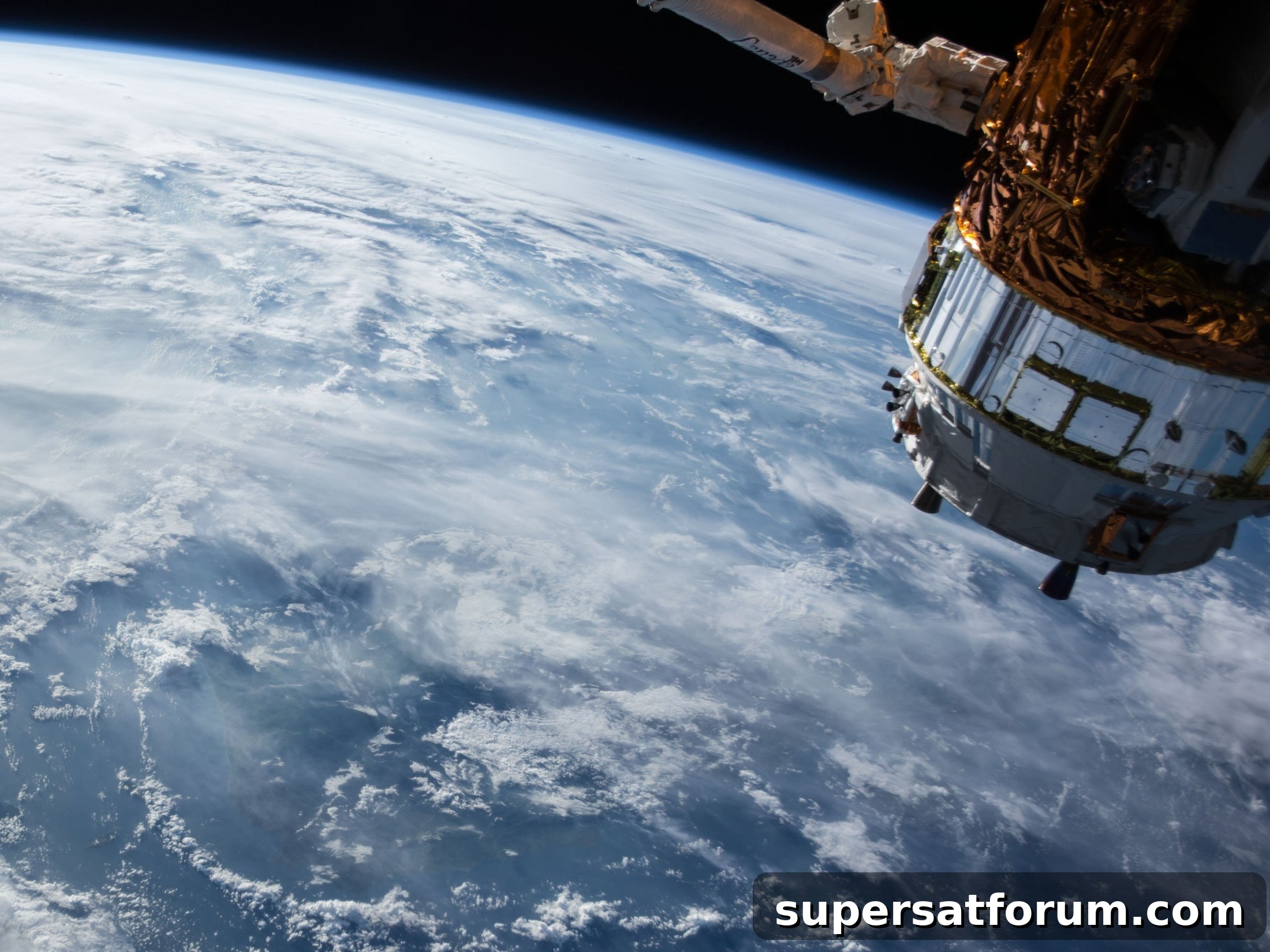
Fujitsu and Yamaguchi University have shown that orbital edge computing can slash satellite data latency from hours to minutes.
For satellite imagery, the delay between capture and usable insight has long been a bottleneck. The conventional process—collecting data in orbit, transmitting large raw files to ground stations, and processing them on terrestrial servers—introduces delays often measured in hours.
By moving processing to the satellite, this team demonstrated that analysis can be completed within about 10 minutes. That reduction brings satellite-derived intelligence much closer to real time and expands possibilities for industries that need immediate situational awareness, such as maritime logistics.
The orbital edge: reducing data gravity
Data gravity is especially pronounced in aerospace. Synthetic Aperture Radar (SAR) satellites produce vast volumes of raw data by illuminating the Earth’s surface with microwave pulses. Traditional architectures require that this raw data be downlinked to Earth for processing, creating a major bandwidth and time bottleneck.
The Fujitsu–Yamaguchi University prototype shifts the compute load onto the satellite itself. By processing SAR data onboard, the system delivers actionable intelligence—demonstrated in this trial by deriving ocean surface wind speeds—without requiring massive downlinks of raw files.
Filtering and analyzing data at source reduces bandwidth costs and enables immediate integration of results into decision-making loops. In the validation tests, the system converted radar reflection intensities into accurate wind-speed estimates at spatial scales of several hundred metres.
Engineering for edge computing on a LEO satellite
Implementing edge computing in low-Earth orbit (LEO) introduces engineering challenges not seen in terrestrial data centers: constrained power budgets and exposure to cosmic radiation.
Small satellites typically operate on tight power limits—often under 20 W—while high-performance processing usually requires significantly more power. The prototype addresses this by dynamically managing computing resources and scheduling program execution to keep performance within the satellite’s power envelope and avoid triggering safeguards.
Radiation tolerance is equally critical. Cosmic rays can cause transient “soft errors” that corrupt data or crash systems. To mitigate this, the team used a redundant hardware configuration with standby processors to detect faults, and developed a custom software environment that can handle resets and re-computations autonomously.
This combination of redundancy and adaptive software enables recovery from radiation-induced faults that would otherwise cause time-outs. In comparative trials where conventional systems failed to complete reprocessing within a 10-minute window, the edge computing approach reduced retry times to 5.6 minutes, delivering processed results within the target interval.
Operational use cases: beyond simple imagery
The real value for businesses lies in actionable outputs rather than raw files. Generating Level-2 data (derived, observed quantities) onboard is the key differentiator. In the validation trial, the satellite produced not just images but precise ocean wind-speed measurements.
That capability has immediate implications for maritime safety: real-time detection of high-wind zones can trigger alerts to vessels, improving situational awareness and safety. The system also distinguishes genuine environmental signals from noise; for example, fixed objects such as ships and bridges that might appear as spurious “windy” returns in raw radar data are identified and filtered out.
Fujitsu notes the approach is not limited to SAR; the same architecture can be applied to optical and hyperspectral instruments. That extends potential commercial applications to agricultural monitoring, infrastructure inspection, disaster response, and other domains where reducing data latency by even a few hours can change outcomes.
Commercialising satellite edge computing
Fujitsu plans to offer this capability as a platform rather than a closed proprietary product. The company intends to release its programming environment, named “Fujitsu Research Soft Error Radiation Armor,” to users in Japan in February 2026. Built on Linux, Python, and open-source components, the library simplifies implementing error detection and automatic restart routines.
This open approach aims to nurture an ecosystem around the architecture. By providing software-level radiation-hardening tools, Fujitsu lowers the technical barrier for organisations seeking to deploy AI and data-processing workflows in orbit.
The development broadens the definition of the “edge” to include orbital assets. As low-power, radiation-tolerant computing becomes practical, expectations for geospatial data latency will shift from hours toward minutes.
Organisations that depend on remote sensing should monitor the maturation of satellite edge computing. Getting a direct answer such as “wind speed: 20 m/s” instead of waiting for raw files enables faster, more responsive supply chains and operational decisions. The scheduled software release in 2026 marks a practical timeline for when these capabilities may begin to see wider adoption.
See also: Samsung and SK Telecom partner on AI-RAN for 6G infrastructure
Want to learn about the IoT from industry leaders? Check out IoT Tech Expo, held in Amsterdam, California, and London. The event is part of TechEx and co-located with other leading technology conferences.
Telecoms content is provided by TechForge Media. Explore other upcoming enterprise technology events and webinars through the organiser’s event listings.